Somewhere out there, someone owes you money. Not dramatic money — a covered dinner, half a birthday gift, the concert ticket you fronted in March. Individually forgettable, which is exactly the problem: forgettable debts get forgotten, and always by the person who owes rather than the person who's owed.
Tracking informal debts is a solved problem with several workable solutions. Here are the five approaches people actually use, what each is good for, and where each one fails.
1. Memory
The default, and not always wrong. For a single small IOU with a reliable friend — they know, you know, it'll come back next week — writing it down is overkill.
Where it fails: volume and time. Memory handles one debt for one week; it does not handle six debts across four people for three months. Worse, memory is asymmetric: as anyone who has lent money knows, the borrower forgets faster than the lender. Every "wait, I paid you back for that" argument is two honest memories disagreeing, with no record to arbitrate.
Verdict: fine for one small, short-lived IOU. Nothing else.
2. A notes app
One step up: a note called "Owed" with lines like Alex — 40 (dinner 3/12). Cheap, instant, always in your pocket, and infinitely better than memory because it exists outside your head.
Where it fails: arithmetic and updates. The note records events, not balances — when Alex pays back 25 of the 40, you're editing text and doing subtraction. Partial repayments, multiple debts with the same person, or anything owed in both directions turn the note into a puzzle. And the note is unilateral: Alex has never seen it, so it settles nothing in a dispute.
Verdict: good capture, bad ledger. Works if you have very few debts and settle them whole.
3. A spreadsheet
The engineer's answer. Columns for person, amount, date, note; a pivot or SUMIF for balances. Genuinely powerful: handles partial payments, both directions, even multiple currencies if you're disciplined.
Where it fails: friction and solitude. Entering a row means opening a spreadsheet, which means "later", which means never. Shared money involves two people, and your spreadsheet involves one — the other party has no view and no buy-in. Most personal debt spreadsheets are meticulously structured and three months stale.
Verdict: the right data model in the wrong container. If you love spreadsheets enough to actually maintain it, it works. How to calculate who owes whom gives the formula to put in it.
4. The group chat
Nobody chooses this system; it emerges. Someone posts a receipt photo, someone replies "I'll get you back", and the chat becomes the de facto record.
Where it fails: everything except capture. Chats are append-only streams — amounts scroll away, nothing nets anything out, and answering "where do we stand?" means scrolling through weeks of messages interleaved with memes. The record technically exists and is practically unusable, which may be worse than no record: everyone feels tracked-for without anyone being able to produce a number.
Verdict: fine as the place where the receipt photo lands first. Terrible as the ledger.
5. A dedicated ledger app
The purpose-built answer: an app whose whole job is balances between you and people. Every entry is either an expense (possibly split) or a repayment, and the app maintains a running per-person balance so "who owes me?" is a glance, not a reconstruction.
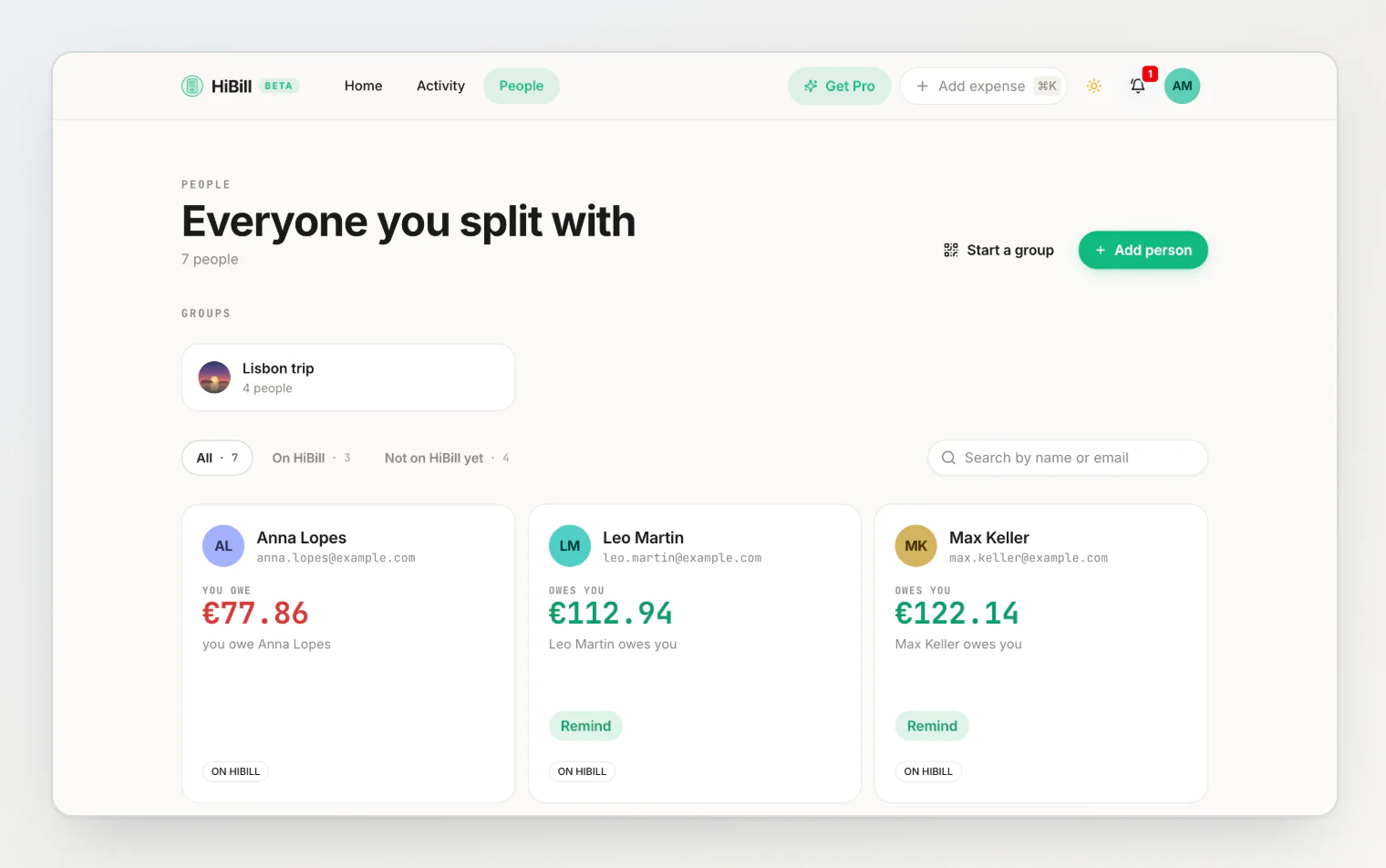
What separates a good one from a digital notes app:
Balances, not just lists. The tool does the netting: three dinners, one repayment, and a fronted ticket collapse into one number per person.
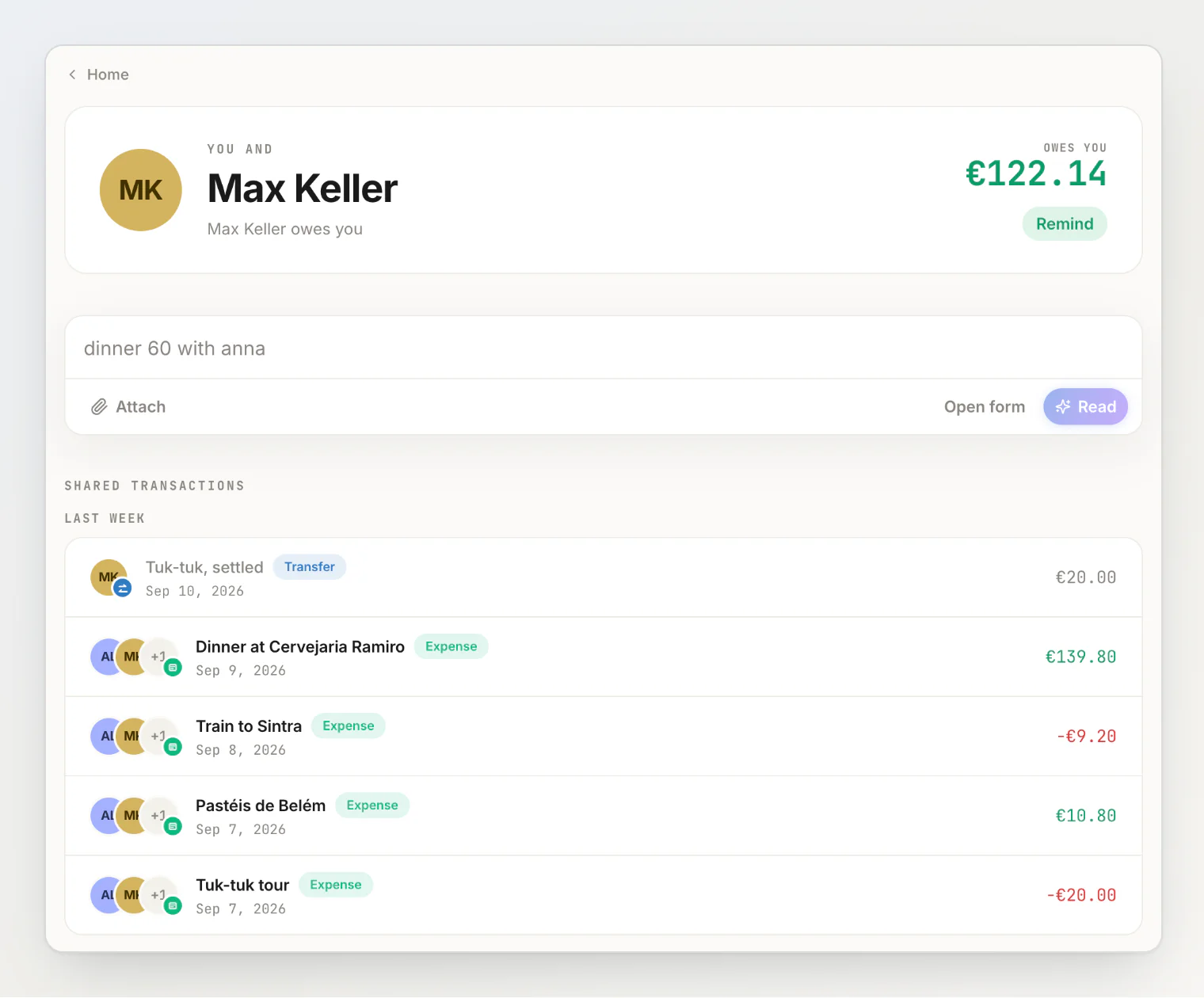
Both kinds of entry. Money you spent on someone and money that moved between you are different events; the ledger should record both and keep them in one timeline.
No sign-up required from the other side. You should be able to track against anyone — as a placeholder — whether or not they install anything. If they join later, the history links up.
Search. "That thing at the airport in June" should be findable by person, amount, or the note you scribbled.
A shared view when both people want it. The strongest property a record can have is that both parties see the same number. That single fact dissolves most disputes before they start.
This is the category HiBill lives in: a quiet per-person ledger where expenses and repayments share one timeline, balances read in plain language ("Max Keller owes you" under the amount, rather than a bare row), and you can nudge someone with a reminder instead of composing an awkward message from scratch.
Where it fails: the same place every system fails — entry discipline. An app reduces the cost of recording to seconds, but seconds still require the habit. No tool survives "I'll add it later."
Verdict: the only approach that scales past a handful of debts without decaying.
The habit that makes any system work
Whichever approach you pick, one rule does most of the work: record at the moment the money moves. When you cover the bill, write it down before pocketing the card. When someone repays you, log it before saying thanks. A system updated in real time is trustworthy; a system updated weekly is fiction with formatting.
And one rule for the human side: the record is a memory aid, not a weapon. The point of knowing who owes you money is to be relaxed about it — to lend the fifty without a knot in your stomach, because nothing depends on your memory anymore. Track quietly, settle warmly, and let the ledger do the remembering.
Continue reading
How to ask a friend to pay you back — what to say once a balance has been sitting there too long.
Debt Simplification Explained: How Circular Debts Between Friends Cancel Out — why fewer balances are left to track when debts run in a circle.
How to Split Expenses with Someone Who Isn't on the App — keeping a record against a friend who never installs anything.