Splitting a bill between three friends is a solved problem. Splitting one between nine is a different sport. The receipt is as long as your forearm, two people left before dessert, somebody ordered for the table, and the server is now being asked to run six cards for six oddly specific amounts. Whatever method your group uses at small tables, it does not survive contact with a large one.
This is a guide to the big-table case specifically: why the usual approaches collapse past six or so people, and the pattern that replaces them — one card pays, everyone claims their own share afterward, and nobody does arithmetic at the table. (If your table is small and you're weighing methods, we've written a separate guide to seven ways to split a restaurant bill.)
Why big tables break every method
Each familiar approach fails at scale for its own reason:
Paying separately fails mechanically. Asking a server to run six cards for exact amounts is slow, error-prone, and hostage to whoever's math is wrong. Many restaurants simply refuse past a certain party size.
The even split fails on fairness. At three people, order differences are usually noise. At ten, the spread between the person with three cocktails and the person with soup and tap water is real money — and large tables reliably contain both people. The bigger the group, the more likely an even split quietly taxes someone.
Itemizing at the table fails on labor. Reading a thermal receipt aloud and asking "who had the arancini?" works at four people and becomes a forty-minute reconstruction at ten — usually performed by one increasingly unpopular volunteer, after some of the participants have already gone home.
Memory fails on rounds. People arrive late, leave early, order in waves. An hour and two bottles in, nobody reliably remembers who had what — which sinks any method that depends on a central person knowing.
The common thread: every one of these tries to resolve the whole split live, at the table, through one person. That is the actual bottleneck. Remove it and the size of the table stops mattering.
The pattern: one card pays, the split happens later
The smoothest large-group mechanics are almost embarrassingly simple: one person pays the whole bill, and payment is decoupled from splitting. The server runs one card. The table leaves. The fairness question gets answered on phones over the next few minutes — or that night — with the receipt in front of everyone, no time pressure, and no one holding the table hostage.
For this to work, two things need to be nearly effortless: capturing the bill, and dividing it without a central bookkeeper. Both are now genuinely easy.
Step 1: capture the bill in one photo
A fifteen-line receipt is exactly where manual entry dies. Don't type it — photograph it. The payer attaches the receipt photo, marks it as a Bill and presses Read: HiBill reads the total, currency, date and the individual line items into a review, and the payer checks it and presses Add. The messiest bill of the month becomes a single photo taken while putting the card away.
Step 2: let everyone claim their own share
Here's the move that deletes the bookkeeper role entirely: instead of one person assigning items to nine people, share the expense by link and let each person claim what they had from their own phone. Tap the dishes that were yours, mark your share of the plates the table split, done. Per-item quantities are handled too — if someone had two of the dumplings, they claim two.
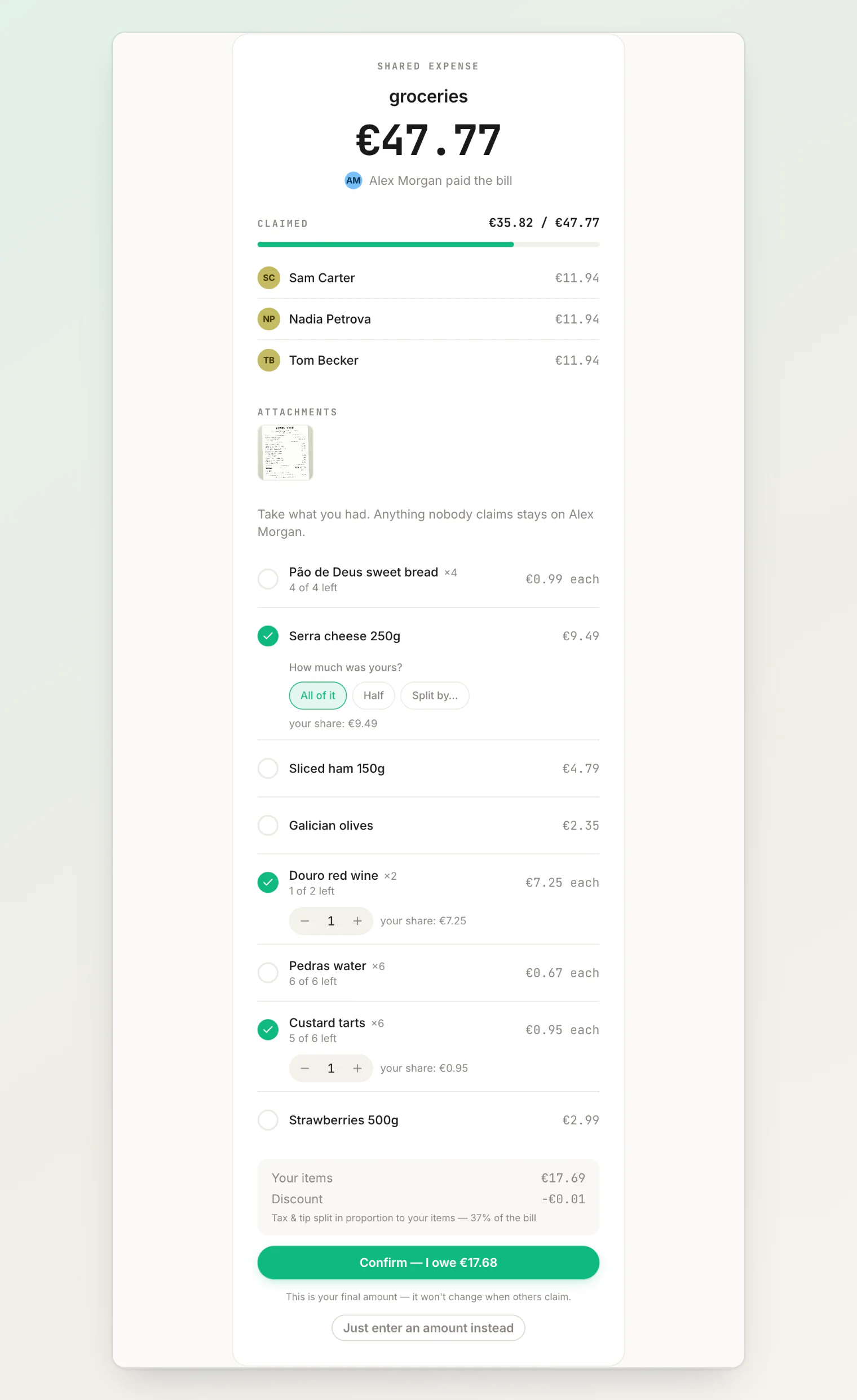
Two properties make this converge instead of stalling:
Anything nobody claims stays with the payer. The split is never stuck in limbo waiting on the one person who doesn't open their messages; the unclaimed remainder has a defined home by default.
The payer keeps control. If claiming drags on, the payer can stop sharing and take back control of the split to finish it themselves, keeping everything already claimed.
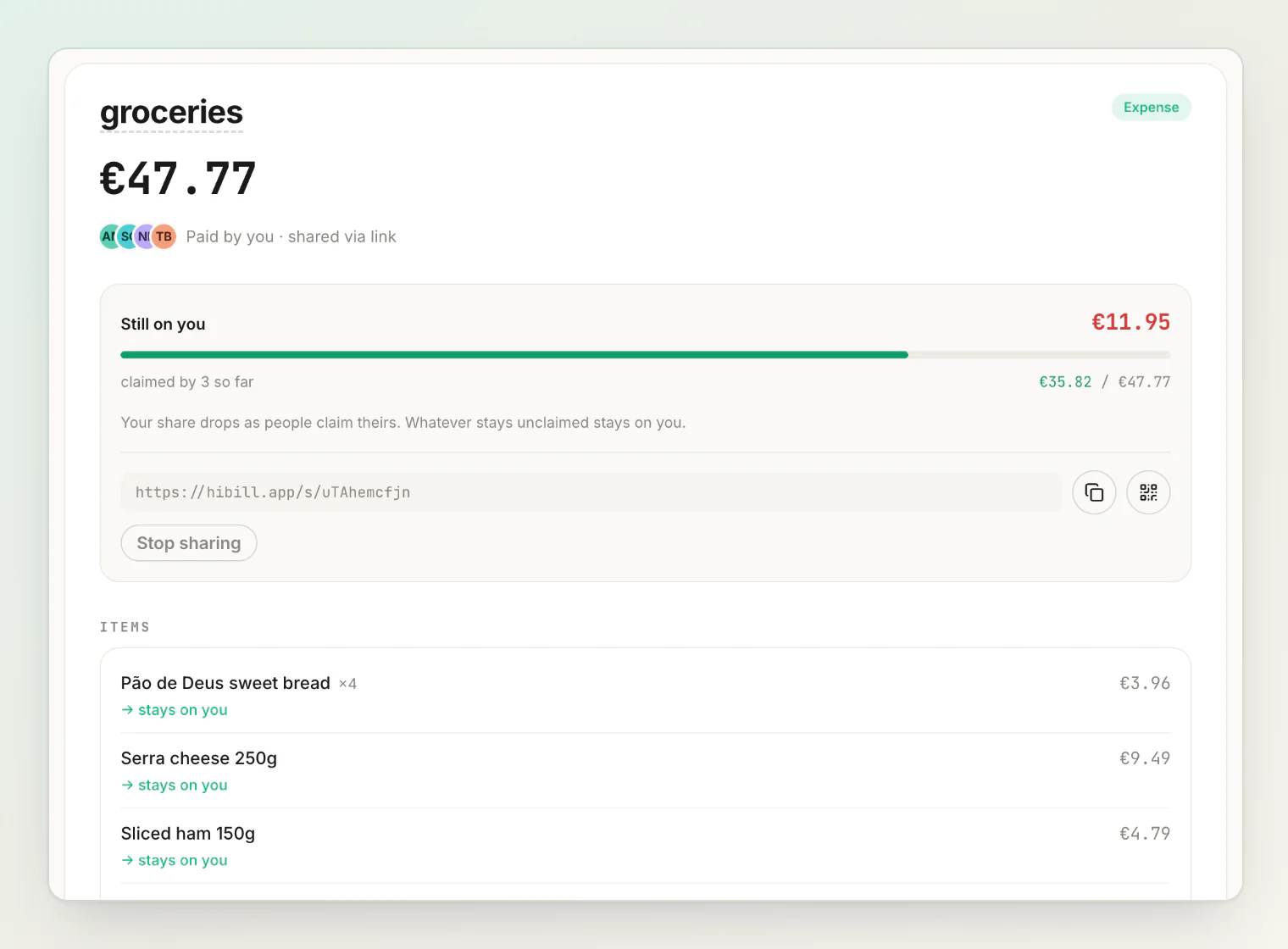
Choose this route when it earns its keep: genuinely divergent orders, people who came and went, drinkers and non-drinkers on one bill. If the table actually ate evenly — one big shared feast, comparable orders — skip the ceremony and split evenly across the group. The one-payer pattern works identically either way; claiming is for when even isn't fair.
Tax, tip, and service: follow the items
The classic large-table mistake is itemizing the food and then splitting the tip evenly. Tax and tip scale with what was ordered, so on an itemized bill they should be allocated in proportion to each person's items — otherwise the soup person pays tip on the steak, and the itemizing was for nothing. The arithmetic is tedious by hand, which is why tables skip it; HiBill applies tax and tip proportionally across claimed items automatically, or equally if the group prefers to treat service as a shared cost of the evening. Either is defensible — as a decision, not an oversight.
Settling: balances, not a flurry of transfers
Once shares are claimed, each person's amount lands on their running balance with the payer — and this is where per-person balances beat same-night payment demands. Repayments get logged as transfers whenever they actually happen. Someone short this week pays next week, and the ledger remembers so nobody has to. If it's a group that eats together regularly, let balances ride and settle monthly: one transfer each instead of twelve small ones per dinner. A polite built-in reminder covers the balance that sits too long — no awkward message to compose.
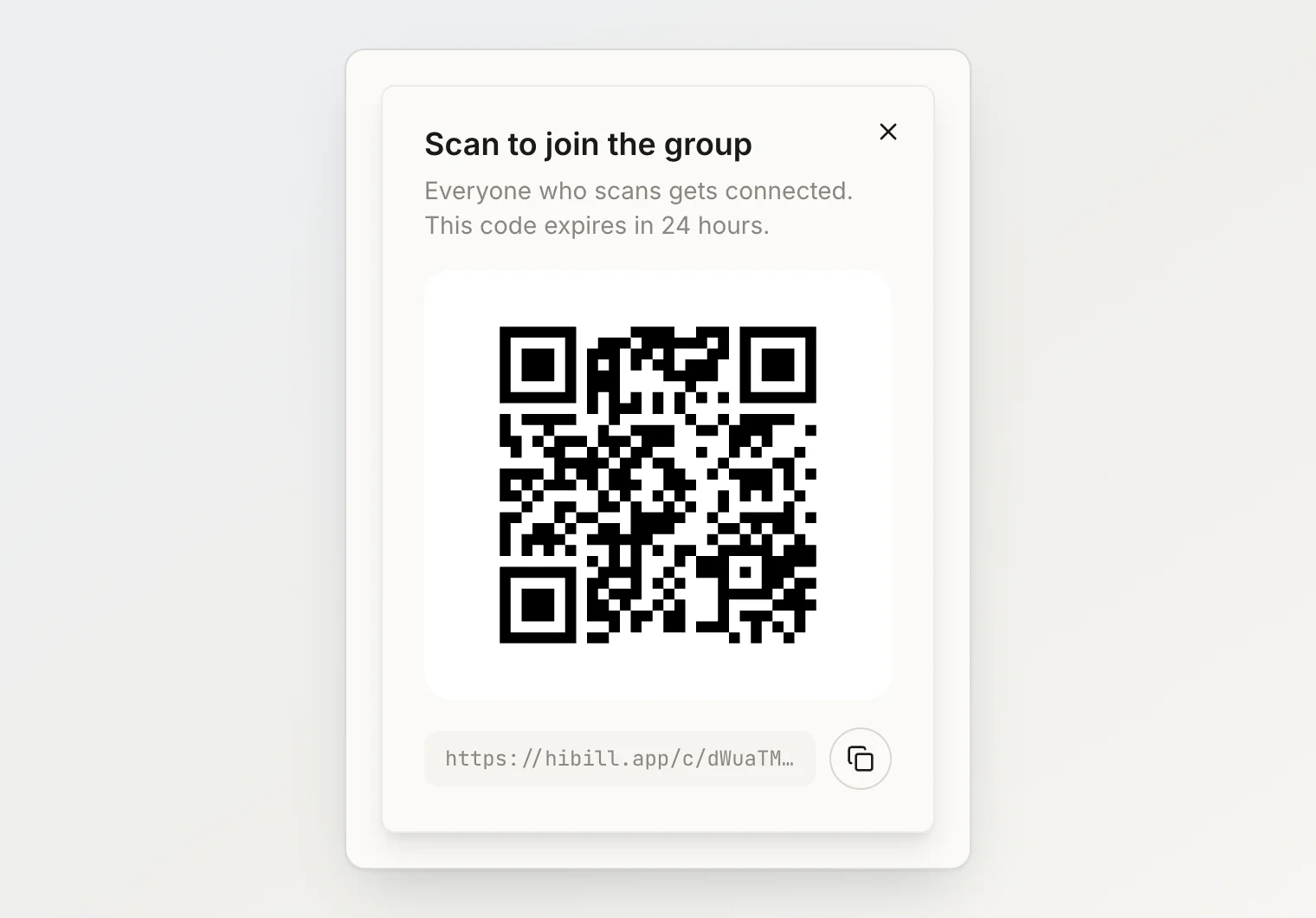
Groups that do this often can set up once: a HiBill group — one QR code or link at the first dinner — connects everyone to everyone, so future bills add the whole roster in a tap. The group holds no money; balances stay between pairs of people. And the friend who refuses to install anything? The payer tracks them as a placeholder, and the history links up if they ever join.
The one sentence that makes it work
All of this compresses into a single line said as the bill lands: "I'll get this one — I'll send a link, claim what you had." No negotiation, no calculator, no queue of cards. One payment, one photo, one link, and a table of ten leaves as fast as a table of two.
The bigger the group, the more the evening deserves protecting from its own accounting. Pay once, split later, and let the arithmetic happen where it belongs — quietly, afterward, on phones.
Continue reading
How to split a restaurant bill fairly: 7 methods that actually work — the methods for smaller tables, and when each one is the right call.
How to split a restaurant bill by item without tapping through a list — claim your items by writing one sentence instead of tapping through the receipt.
Using open splits — how to share a bill by link in HiBill and follow the claims as they come in.