The bill arrives. Somebody picks it up, looks at it for slightly too long, and says the sentence that decides the next ten minutes: "Shall we just split it evenly?"
Sometimes that is the right answer. Often it is the answer that ends the conversation fastest, which is not the same thing. Someone at that table had a starter, two glasses of wine and the steak; someone else had soup and tap water. Everyone knows it. Nobody wants to be the person who says it.
This is a guide to the seven ways a group can actually divide a restaurant bill, what each one costs in fairness and in friction, and how to pick between them before the awkwardness starts rather than after.
The only question that really matters
Before the methods, one diagnostic. Almost every argument about splitting a bill comes down to a single number: how far apart were the largest and smallest orders?
Within about 20% of each other. Split evenly. The arithmetic of fairness costs more than the unfairness it corrects.
One or two people clearly out of line. Split evenly with exceptions.
Genuinely all over the place, or the table is large, or people ordered in different rounds — itemize, or let people claim their own.
Most tables are the first case and act like the third. A few are the third and act like the first, and someone quietly resents it for a week.
Method 1: Split it evenly
Take the total, divide by the number of people, done.
Use it when orders were broadly comparable, the group eats together often, and the differences will average out over the next few months anyway.
The real argument for it is not arithmetic, it is social. An even split says we are the kind of group that does not audit each other. That is worth something, and often worth more than the €6 it costs the person who had the soup.
Where it breaks: it stops being a generous convention and starts being a subsidy when the same person is on the losing end every time. The non-drinker in a group of drinkers is the classic case. If someone has been quietly underwriting the wine for two years, an even split is not neutral — it is a bill they never agreed to.
Watch the rounding. Dividing €96.40 by three does not produce three equal numbers. Someone has to absorb the cent. Whatever you use to track this should say who did, rather than silently dropping it.
Method 2: Split evenly, with exceptions
The pragmatic middle. Pull out the one or two line items that are obviously not shared — the bottle of wine three of the six people drank, the dessert one person ordered for the table — assign those directly, then split the rest evenly.
Use it when the meal was mostly communal but had one clear outlier. This covers a surprising share of real dinners.
How to run it without a spreadsheet: name the exception out loud before the bill comes, not after. "We'll put the wine on the four of us" is an easy sentence at 8pm and a loaded one at 11pm.
Where it breaks: exceptions multiply. Two is fine. Five means you are itemizing badly and should just itemize properly.
Method 3: Itemize, line by line
Assign every line on the receipt to whoever ordered it. Shared plates get split across the people who ate them.
This is the fairest method and everybody knows it. It is also the reason bill-splitting has a bad reputation, because doing it by hand at the table with a phone calculator is genuinely miserable — reading a thermal-printed receipt upside down, asking "who had the arancini?" four times, and losing track twice.
Use it when orders differed a lot, the group is small enough to remember who had what, or the total is large enough that the differences are real money.
Make it survivable: photograph the receipt and let software read the lines, then assign them. In HiBill, scanning a receipt pulls out the title, total, currency, date, line items, tax and tip into a review you check and confirm with Add. Assigning those lines to people — including splitting a single shared plate fractionally between two of them — is covered in itemizing a bill line by line.
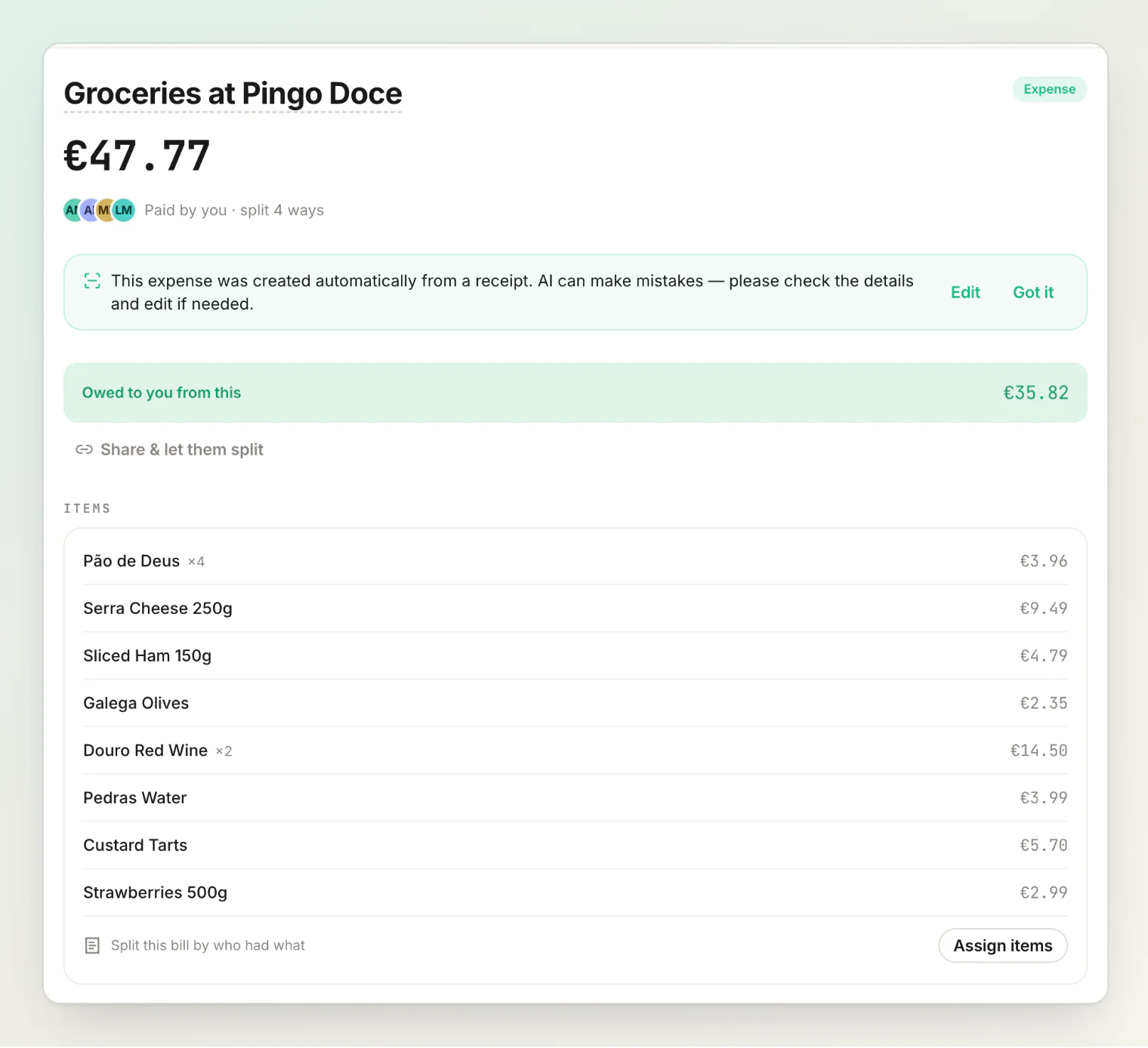
We wrote about why receipts are such a hostile document format, and why every scan is shown to you before anything is saved, in what we learned reading thousands of receipts.
Where it breaks: at eight or more people, itemizing centrally becomes a job. One person ends up doing forty minutes of data entry for a group that has already gone home. That job is what Method 5 exists to delete.
Method 4: Split by percentage
Agree shares as percentages of the total — 40/30/30, or 50/25/25 — rather than by item.
Use it when the difference between orders is real but not worth itemizing, or when the split follows something other than consumption: a couple counting as one share and a half, a colleague expensing part of a working dinner, a birthday where the guest of honour pays nothing.
Use it also for bills where the categories differ, not the items. Food split evenly, wine 70/30 because two of you drank most of it.
Where it breaks: percentages hide their own arithmetic. 33/33/33 is not 100, and someone will notice on the bank statement. Whatever you use should force the percentages to close.
Method 5: Let everyone claim their own share
Instead of one person dividing the bill, publish it and let each person say what they owe.
This inverts the work. Rather than the payer chasing nine people for what they had, the payer posts the bill once and each person claims — an equal share, a specific amount, or the items they actually ordered. The payer's job goes from forty minutes of reconstruction to sending one link.
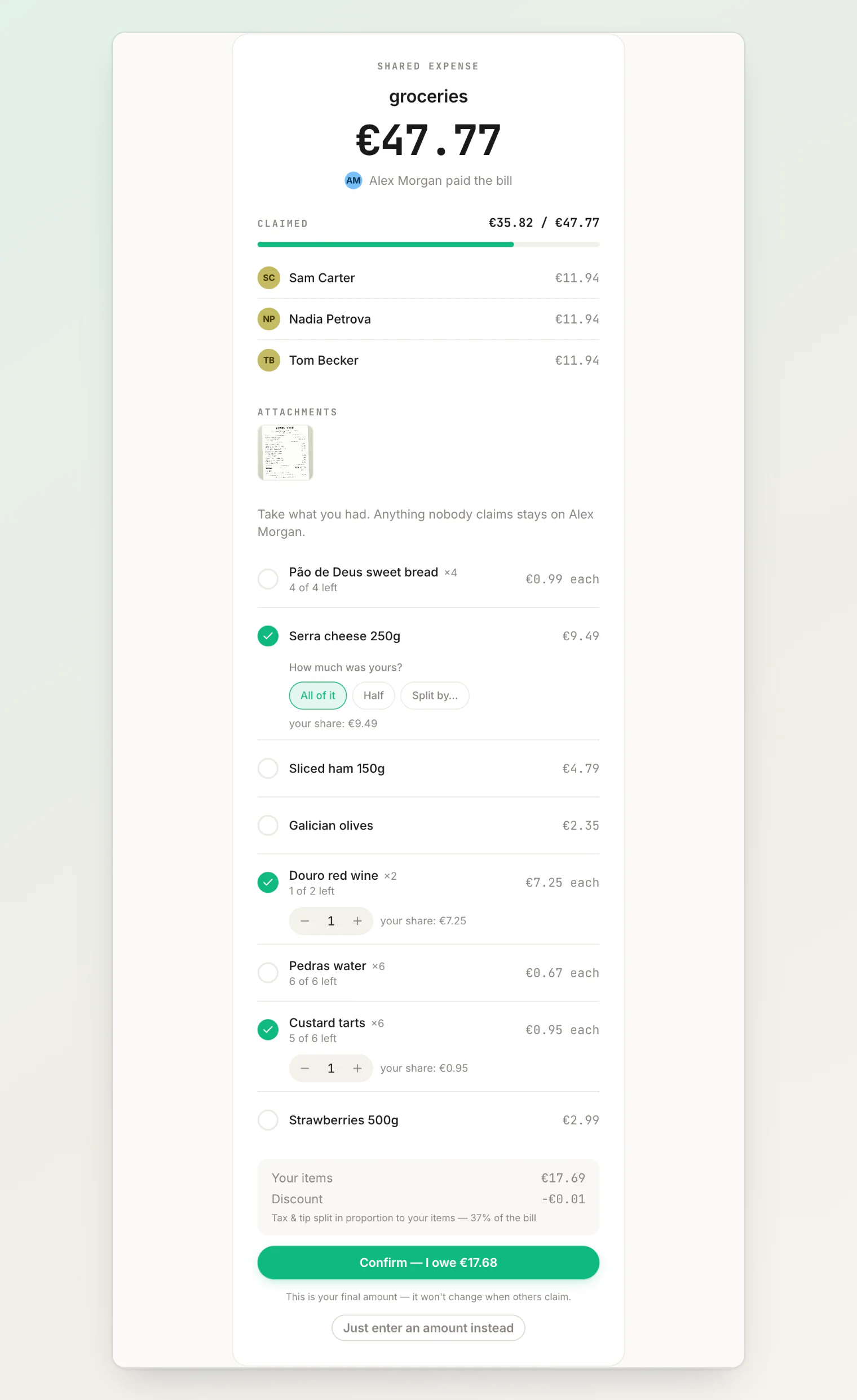
Use it when the table is large, people arrived and left at different times, or you genuinely cannot remember who had what — which, an hour and two bottles in, is most large tables.
In HiBill this is what happens when you share a bill: the split opens up and anyone with the link can claim part of it. Two details matter. First, whatever nobody claims stays with the person who paid — so the bill is never stuck in limbo waiting on the one person who never opens their messages. Second, sharing is reversible: if the claiming stalls, you can turn sharing off and take the split back with everyone's claimed amounts intact, and finish it yourself.
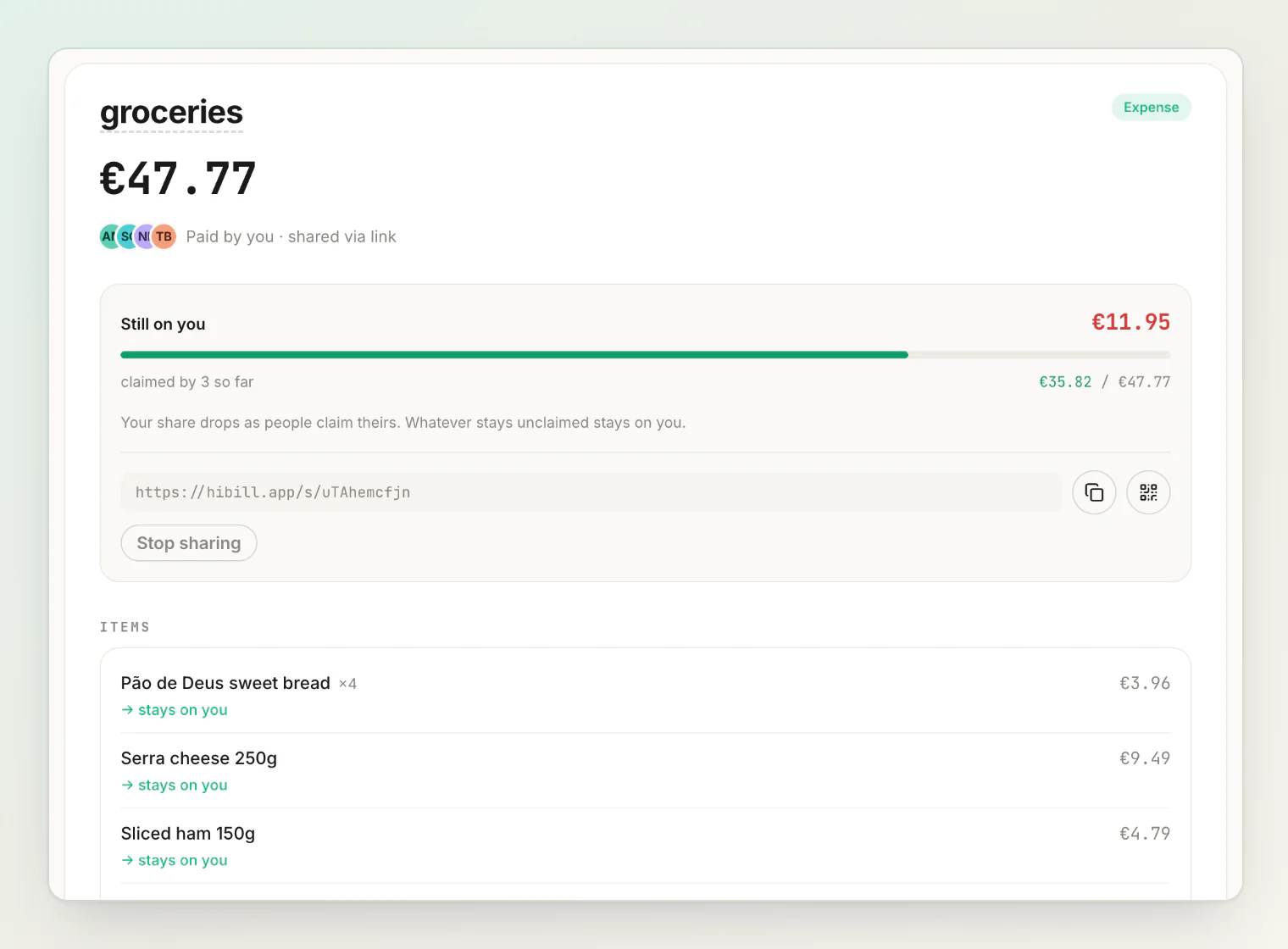
Where it breaks: it depends on people actually claiming. Assume some fraction will not, and pick this method only when the unclaimed remainder landing on the payer is an acceptable outcome rather than a disaster.
Method 6: Rotating payer
Nobody splits anything. One person takes the whole bill, and next time it is someone else.
Use it when the group eats together regularly, the meals are comparable in size, and the relationships can carry a bit of imprecision. Two friends who get lunch weekly do not need a ledger; they need to alternate.
The failure mode is memory. "I think I got the last one" is a claim nobody can check, and over a year the drift is real — not because anyone is dishonest, but because paying is memorable and being paid for is not. The fix is not to abandon the method, it is to write down who paid without turning it into a settlement each time. Which is Method 7.
Method 7: Keep a running balance and settle rarely
Record each meal as it happens, let the numbers accumulate between two people, and settle when the balance gets large enough to bother with — or when one of you moves away.
This is less a splitting method than a posture toward the other six. Any of Methods 1 through 5 can feed a running balance instead of triggering an immediate payment. You still decide how each individual bill divides; you just stop making everyone move money on a Tuesday over €11.
Use it when the same people share costs repeatedly: couples, flatmates, close friends, a regular group. Settling every bill individually is a lot of bank transfers to arrive at roughly the same place.
In HiBill, a balance is always between two people, in one currency — there is no group pot to reconcile. Settling is not a special ceremony either; it is just a transfer that happens to bring the balance to zero, and it can be partial. And when debts form a loop — you owe Ana, Ana owes Ben, Ben owes you — simplifying collapses the loop into fewer payments, writing a visible entry so no balance ever moves without a reason you can read.
Tax, tip and service charge
The part every method has to answer, and most people get wrong in the same direction.
Do not split tax and tip evenly on top of an itemized bill. If tax is a percentage of the total, it is a percentage of each person's items too. Splitting a €14 tax charge evenly across four people when one of them ate €60 of the €120 bill quietly undoes the itemizing you just did.
The correct handling is proportional: each person's share of the tax and tip matches their share of the food. It is tedious by hand, which is exactly why it gets skipped. Tools should do it for you — HiBill keeps tax, tip and service as separate components and apportions them across the split rather than dumping them into the head count.
Discretionary tips are different. A service charge already on the bill is part of the bill. A tip you choose is a decision the table makes together, and it is reasonable for someone to opt out of a 20% tip they did not agree to. Decide it once, out loud, rather than having it silently distributed.
Discounts and vouchers follow the same logic as tax: proportional, unless the voucher was specifically for one dish, in which case it belongs to whoever ate it.
The awkward cases
The person who did not drink. The single most common source of quiet resentment in bill splitting. Alcohol is often 30–40% of a restaurant bill and is the least evenly consumed item on it. Pull drinks out and split them among the drinkers; split the food evenly. This is Method 2 and it takes ten seconds.
The person who arrived for dessert. They had one course and 20% of the evening. An even split is indefensible; itemizing the whole bill for one person's benefit is overkill. Assign them their items and split the rest among everyone else.
The person who is short right now. Splitting the bill and being paid for the bill are two different events, and conflating them is what makes this awkward. Record what they owe, let them pay next week. A running balance means "I'll get you back" stops being a promise nobody is tracking.
The person who has not signed up for anything. You should not need everyone on the same app to record a split. In HiBill you can add someone as a placeholder, split with them immediately, and merge the records later if they join — keeping every transaction and the balance.
The birthday. The guest of honour pays nothing and their share divides among everyone else. Say so before ordering, because a table that has not agreed on this will discover it at the worst possible moment.
A short decision guide
Situation | Method |
|---|---|
Similar orders, friends you see often | Split evenly |
One clear outlier — the wine, the extra course | Even, with exceptions |
Very different orders, small table | Itemize |
Uneven shares for reasons other than food | By percentage |
Large table, patchy memory, people leaving | Open claim |
Regular pair or small group, comparable meals | Rotating payer |
Anyone you share costs with repeatedly | Running balance |
Frequently asked questions
Is it rude to ask to split the bill by item? No, and it is markedly less rude than the alternative, which is one person silently absorbing the difference. The trick is timing. Raising it when the bill arrives sounds like an accusation; raising it when the food is ordered — "shall we just pay for our own?" — sounds like logistics.
How do you split a bill when one person pays with a card and everyone else has cash? Treat the payment and the split as separate facts. The card holder paid the restaurant; everyone else now owes the card holder. Cash handed over at the table is a repayment, not a split — record it as one, so the balance reflects who is actually square.
What is the fairest way to split a bill? Itemizing, proportionally including tax and tip. But fairness has a cost in time and friction, and the fairest method is not always the best one for the group. A table of four with similar orders is better served by an even split; a table of ten is better served by letting people claim their own.
How do you split a bill in a different currency? Do not convert it in your head, and be careful with tools that convert it for you at today's rate — the rate moves, and the number you agreed on stops matching the number displayed. We keep balances separate per currency for exactly this reason, which we explain in why we refuse to convert your currencies.
Should tip be split evenly or proportionally? Proportionally, if the meal was itemized. Evenly, if the meal was split evenly. The tip should follow the same logic as the bill it sits on — mixing the two is how you end up with a "fair" split that is not.
The short version
There is no universally correct way to divide a restaurant bill, and any guide claiming otherwise is selling something. What there is: a set of methods, each honest about what it costs.
Pick deliberately, say it out loud before the food arrives, and record the result somewhere other than four people's memories. Most bill-splitting arguments are not really about the money — they are about the split that was never actually agreed to.
Continue reading
How to Split the Bill with a Large Group: One Payer, Claim Links, No Table Math — Method 5 at full scale: one card pays and everyone claims their own share by link.
How to split a restaurant bill by item without tapping through a list — itemizing in one sentence: write what you had and let the receipt divide itself.
Splitting a receipt nobody wants to itemize — share the bill and walk away; whatever nobody claims stays with the payer.