Nine people at a long table. One card pays. Three of them had the set menu, two shared a bottle of wine nobody else touched, one had a salad and left early, and two arrived for dessert.
Splitting that equally is unfair. Itemizing it yourself means sitting with a receipt and nine names asking "was the calamari yours?" for twenty minutes.
Open splits are for exactly this. You share the bill and let people claim their own share.
How it works
Add the expense, then share it — that is what turns it into an open split. Send the link and each person claims what they had.
You do not chase anyone. The bill sits there accumulating claims, and the balances update as people take responsibility for their own portion.
Claiming is not one-size-fits-all. A person can take an equal share, a specific amount, or the line items they actually ordered. Most people take the equal share; the person who only had a salad enters their number.
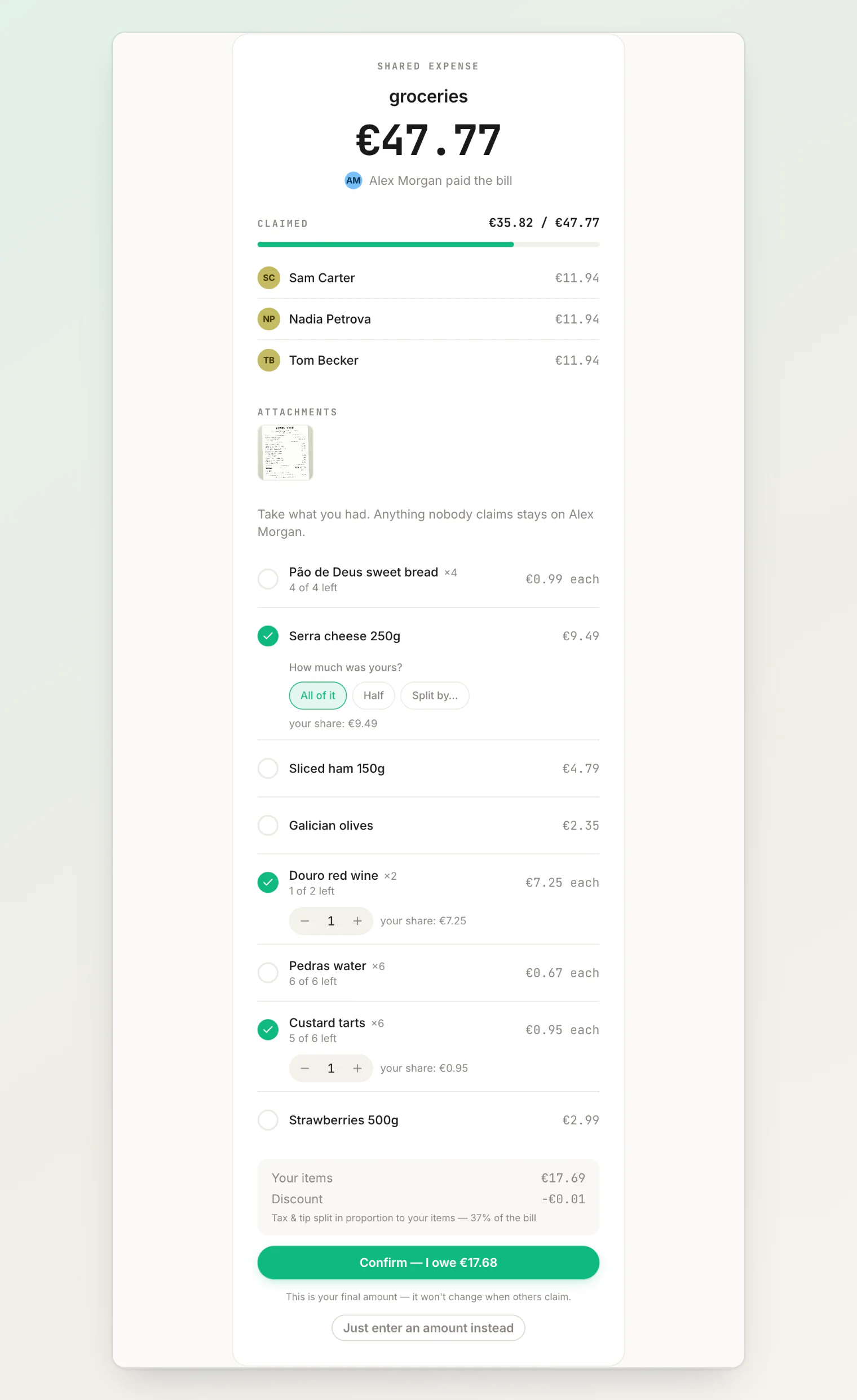
The equal share moves
The part that surprises people: the equal share is not fixed when you post the bill.
Fixed claims — specific amounts and item claims — come off the total first. Whatever remains is divided between everyone in the equal pool plus the payer. So each new equal claimer makes everyone's share smaller:
€120 bill. Two friends join the equal pool → three heads including the payer → €40 each. A third joins → four heads → €30 each.
This is the right behaviour, and it is worth understanding before you wonder why a number changed. The bill is being divided among the people who have actually put their hand up.
The unclaimed part
The obvious question: what happens to whatever nobody claims?
It stays with whoever paid. That is the rule, and it is deliberately the boring one.
If the bill was €240 and claims add up to €200, the remaining €40 is simply the payer's own cost. No error state, no nagging, no transaction stuck half-finished waiting for a straggler. Most of the time that €40 is the payer's dinner, which is why they were the one holding the card.
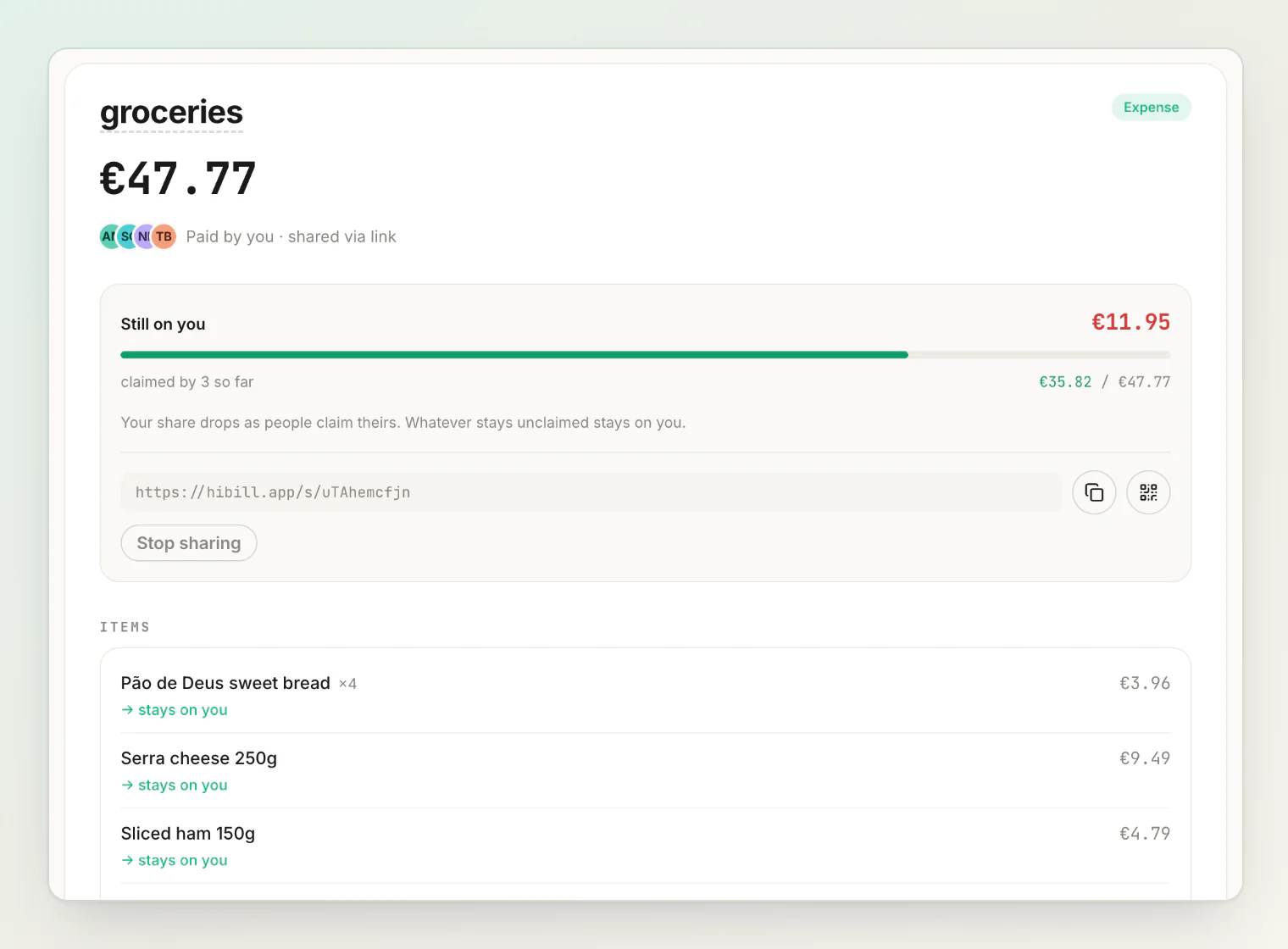
This matters more than it sounds. The failure mode of every "let people claim" feature is that it never reaches a resolved state — one person forgets, and the bill hangs open forever, showing up in everyone's list as unfinished business. By defining the remainder as the payer's cost, an open split is always in a valid, complete state from the moment it is created. Claims refine it; they are not required to make it work.
Over-claiming
Claims can also overshoot. Two people both think they had the expensive thing, and the total comes to more than the bill.
We track it and show it rather than blocking it. The payer's remainder is floored at zero — they can never end up owed money on their own bill — and the over-claim surfaces as a conflict for the people involved to sort out.
Refusing the claim with a validation error would punish the honest case to prevent an arithmetic curiosity. Someone claiming too much is generous, not dangerous.
When to use something else
Open splits are not always the right tool:
Equally is right far more often than people expect. If everyone had roughly the same, use it and move on.
By amount or by percentage when you already know the breakdown and it is uneven.
By items when you scanned the receipt and the line items are already sitting there. Assign each line to a person — faster than open claims when the receipt is detailed and the group is small.
Open splits earn their place with large groups and low patience: when the cost of you working out the split exceeds the cost of everyone spending five seconds on their own.
Pairing it with a scan
The combination we use most: photograph the receipt, let HiBill pull out the total, currency, date and line items, then share it.
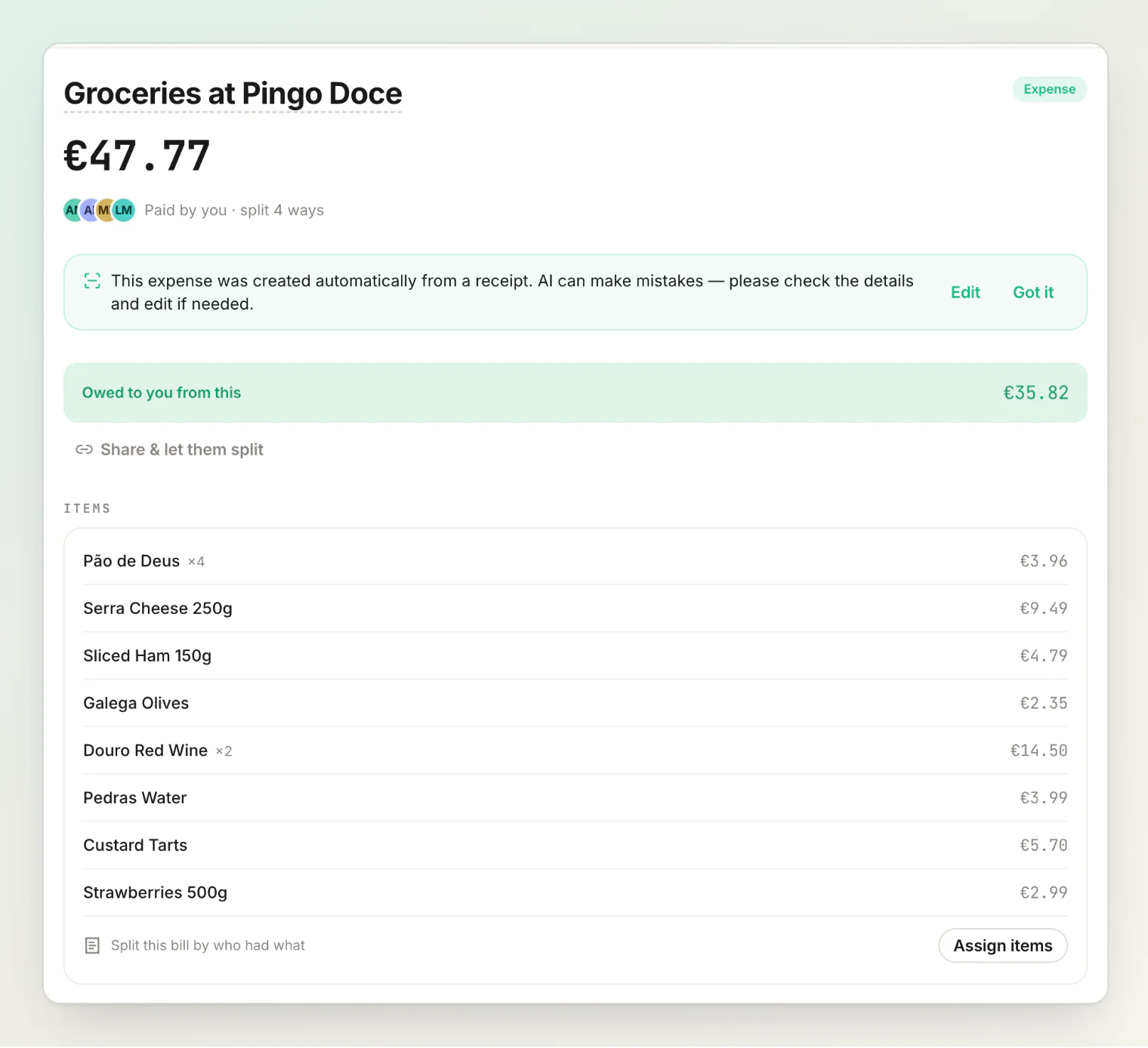
You get an accurate bill with zero typing, and nine people each answer one question about themselves instead of one person answering nine questions about other people. That is the whole idea — push the work to where the knowledge already is.
Open splits are available on every plan, including Free. Receipt scanning is free too, up to five scans a month.
Continue reading
How to split a restaurant bill fairly: 7 methods that actually work — every way to divide a table, and when each one is the fair choice.
How to Split the Bill with a Large Group: One Payer, Claim Links, No Table Math — the claim-link flow for a big table, from paying to everyone settled.
Using open splits — the steps for sharing a bill and following the claims as they come in.