Splitting everything 50/50 sounds fair right up until one of you earns twice what the other does. Then the "equal" split quietly becomes unequal: the lower earner spends a much bigger share of their paycheck on rent and groceries, has less left for themselves, and starts declining plans the other person suggests without thinking. Nobody did anything wrong, but the arithmetic is doing damage anyway. The good news is that couples have been solving this for a long time, and there are really only three models worth considering. The right one depends on your situation — and whichever you pick, it only works if tracking it takes less effort than arguing about it.
The three ways couples split
50/50: equal amounts
Each of you pays half of every shared expense. It's the default because it requires no conversation: rent is $2,000, you each pay $1,000, done.
50/50 works well when your incomes are close — within maybe 20% of each other — or when you both strongly prefer keeping money fully separate. It starts to hurt when the gap widens. If one of you takes home $6,000 a month and the other $3,000, that $1,000 rent share is 17% of one paycheck and 33% of the other. Same number, very different weight.
Proportional: equal percentages
Each of you contributes in proportion to what you earn. Add your take-home incomes together, work out what fraction each of you brings in, and split shared costs by those fractions.
With $6,000 and $3,000 in take-home pay, the total is $9,000 — one of you earns 67% of it, the other 33%. So the $2,000 rent splits into $1,340 and $660. Both of you are giving up the same share of your income, which is a different — and for many couples, better — definition of fair.
The usual objections: it requires disclosing incomes to each other (most couples at this stage already have), and it needs recalculating when someone gets a raise, changes jobs, or goes back to school. Neither is a real blocker; both are just conversations.
Equal leftover: same spending money
The third model flips the question. Instead of asking "how do we split the bills?", it asks "how much does each of us have left after the bills?" You pool enough to cover all shared costs, and structure contributions so that both of you end up with the same amount of personal money afterward.
This is the most generous model and suits couples operating as a single financial unit — often with fully merged finances, at which point you may not need expense tracking between you at all. For everyone else, proportional is usually the sweet spot: fair to the lower earner without requiring you to merge everything.
Deciding what counts as shared
Whichever model you choose, you still need a boundary between shared and personal, and this is where most disagreements actually live. A workable default:
Shared and split by your chosen model: rent or mortgage, utilities, groceries, household supplies, streaming services you both use, joint travel, the pet.
Shared but split evenly regardless of income: things where consumption is genuinely equal and the amounts are small — a takeaway you both ate half of, two cinema tickets.
Personal, not split: your hobbies, your clothes, gifts for your own family, the subscription only you use.
You don't need to get this perfect on day one. Agree on the obvious categories, and when an ambiguous expense shows up, ask one question: did we both choose this? A dinner you picked together is shared. The premium tier of a service only one of you wanted is not.
Making the split survive real life
A model you can't maintain is worse than no model, because it creates the appearance of fairness without the substance. Three things keep it running.
Turn the ratio into a fixed percentage and stop recalculating. Work out your income split once — say 65/35 — round it to something you can both remember, and apply it to everything shared. Don't recompute per expense. Revisit the number when something real changes: a raise, a job change, parental leave.
Track as you go, not at the end of the month. Month-end reconciliation from memory and bank statements is where these systems die. Each shared expense should be recorded when it happens, by whoever paid, in under a minute.
Settle from the balance, not per expense. You don't need to transfer money every time someone buys groceries. Let the balance accumulate, then square up when it feels large enough to matter.
Tracking a percentage split in HiBill
This is exactly the shape of problem HiBill is built for. When you add an expense, you choose how it splits: evenly, by exact amounts, by percentage, or by items. For a proportional arrangement, choose the percentage split on each shared expense and enter your ratio — 65/35, 70/30, whatever you agreed — and HiBill works out both shares and the balance from there. Expenses that should stay 50/50 you just split evenly; the model applies per expense, not per relationship.
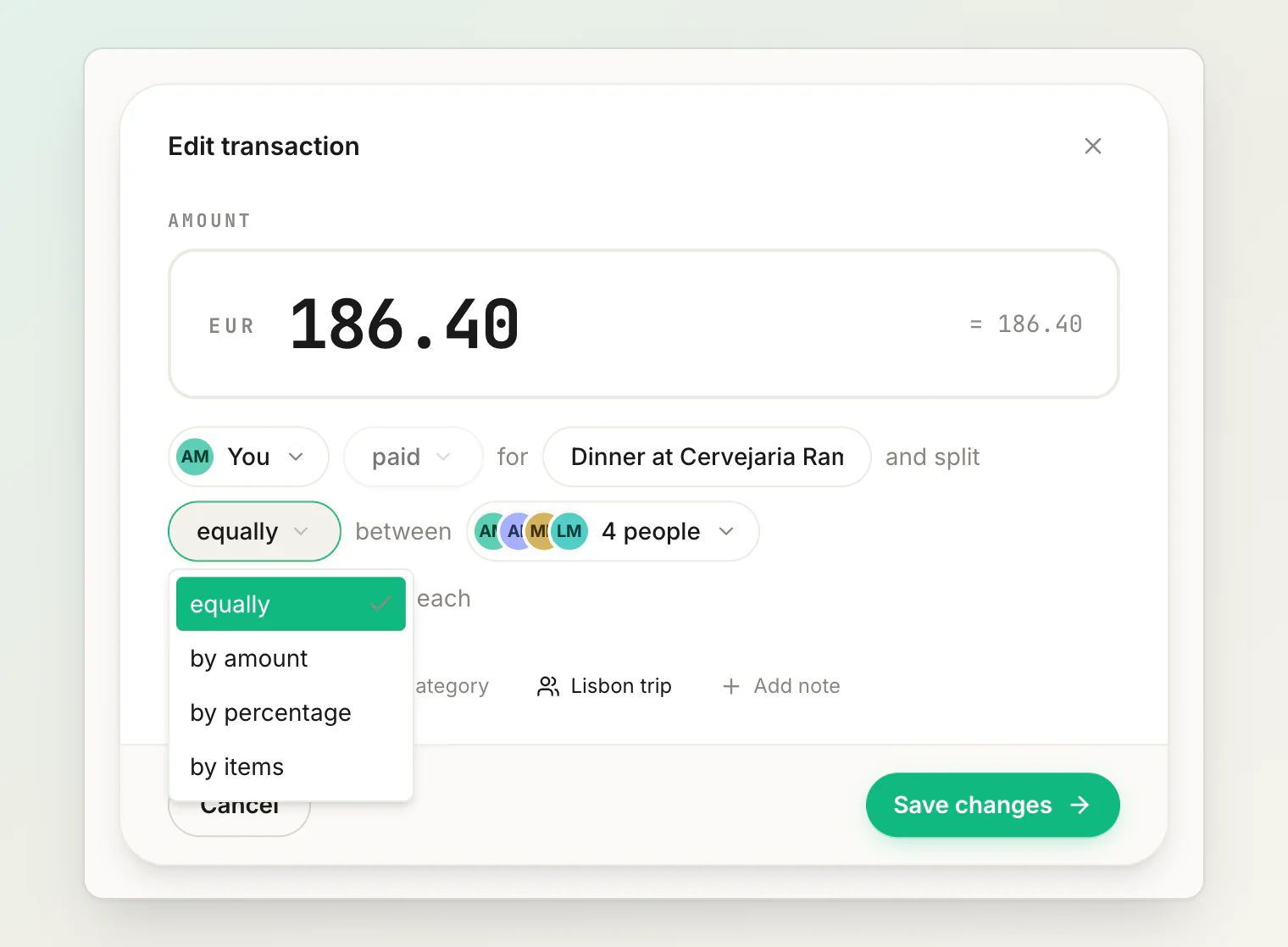
A few details matter for couples specifically:
Either of you can pay. An expense records who actually paid, and if you covered a bill jointly — one card for part, another for the rest — you can record multiple payers on the same expense.
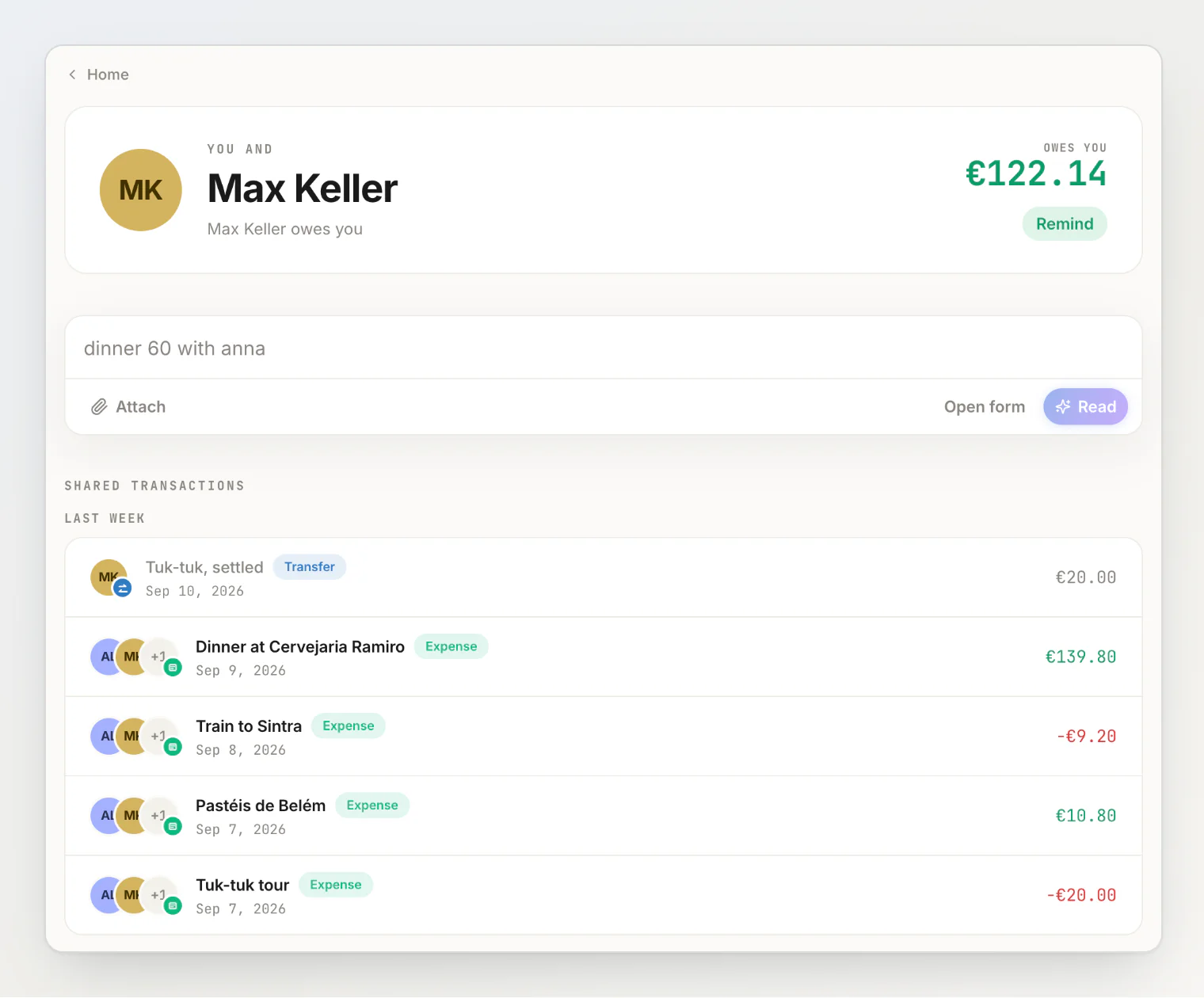
You see one running balance per person, across everything, rather than a pile of individual IOUs. When one of you pays the other back, you record it as a transfer, and it appears on the same timeline as the expenses — one chronological record of who did what for whom.
Your partner doesn't have to be on the app. You can add them as a placeholder and keep the ledger on your own; if they join later, a merge request links the placeholder to their account and the history combines.
Nothing about this requires a shared spreadsheet, a monthly accounting evening, or a joint account before you're ready for one.
The conversation is the hard part — have it once
The uncomfortable truth about unequal-income splitting is that the math is trivial and the conversation is not. But it's one conversation. Agree on a model, agree on a percentage, agree on what's shared, and then let the tracking be boring and automatic. The couples who fight about money are rarely fighting about the model — they're fighting because there is no model, and every expense reopens the negotiation. Pick your ratio, write it down, and go argue about something more interesting.
Continue reading
Choosing a split method — how even, exact, percentage and item splits work when you add an expense.
Splitting rent and bills with roommates: a system that survives the year — keeping rent, utilities and groceries straight month after month.
How to Split Expenses with Someone Who Isn't on the App — keeping the ledger yourself until your partner joins.