HiBill is a ledger for the money that moves between friends — the dinners someone covered, the deposits someone fronted, the fifty that would otherwise be forgotten. It doesn't connect to your bank and it doesn't hold money. You tell it what happened; it remembers, keeps a clean balance with every person you share with, and stays out of the way until you want to look.
This is a tour of how it actually works, model first, because the model is the point.
Two kinds of entry, one timeline
Every dollar that moves between friends is one of two things, and HiBill has exactly two kinds of entry to match:
An expense — one person paid, several people share it. Dinner, rent, the absurd IKEA run. It has a payer (or several), participants, and a split.
A transfer — money changed hands. You paid Sam back, or lent Casey cash. No split, no receipt; the balance just moves the right way.
Most apps treat these as different features — expenses over here, a separate "settle up" flow over there. HiBill collapses them into one chronological timeline per person: expenses and the transfers that resolve them, interleaved in the order they happened. Open anyone you share with and you read the complete story — who did what, for whom, when — and above it, one number: the balance.
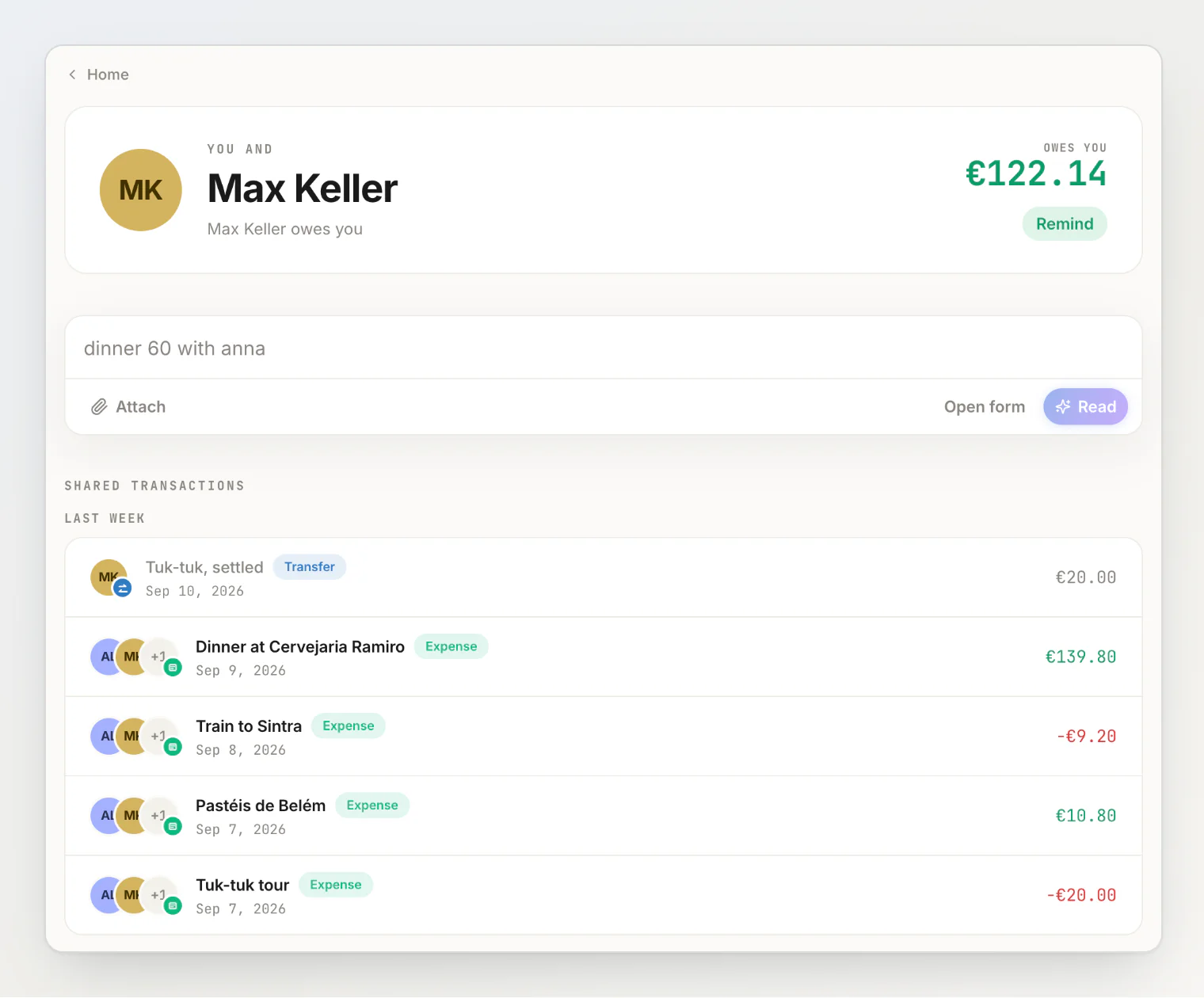
That balance comes with a plain-language caption. Not a bare figure in a table, but the amount with a sentence under it — "Max Keller owes you", "you owe Anna Lopes" — the number rendered as a relationship, which is what it actually is.
Adding an expense: type it or photograph it
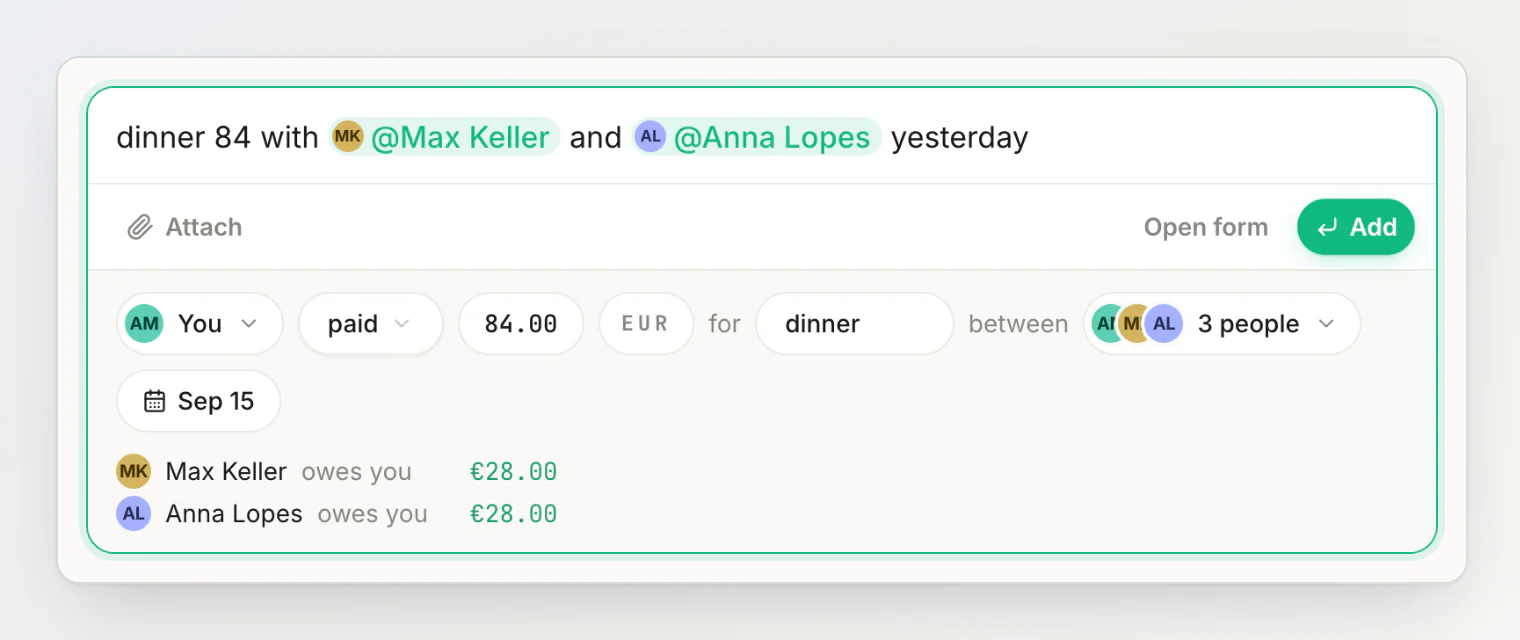
The fast path is typing it as one sentence, in your own words — like dinner 84 with max and anna yesterday — in the field at the top of the dashboard, or anywhere via Add expense (⌘K). Press Read, AI reads it into a review, you check it and press Add; nothing is saved before that. When even isn't fair, the review has real options — split by exact amounts, by percentage, or by items, with support for multiple payers on one bill and per-item quantities ("she had two of the dumplings").
The faster path, for real-world paper: attach the receipt photo in the sentence field, mark it as a Bill, type who shared it and press Read. HiBill reads the total, currency, date and the individual line items into the same review — check it and press Add. Assign items to people or change the split later with Edit if it needs it. Tax and tip are spread in proportion to each person's items.
For big group bills there's a third path: share the expense by link. Each person opens it on their own phone and claims the items they had; anything unclaimed stays with the payer. Nobody interrogates the table.
Balances live per person — groups gather the rest
HiBill's structural opinion: there are no group pots. Every balance is between exactly two people. You and each friend share one two-person ledger no matter how many contexts you share money in — the flat, the trip, the running coffee tab all land on the same clean line.
Groups are for connection and filing, not accounting. A group is a named roster — "Lisbon weekend", "Flat 4B". Create one, show the QR code or share the link, and everyone who joins is connected to everyone else in one tap. From then on you can add the whole roster to an expense at once, and tag transactions with the group so the trip reads as one timeline on its page.
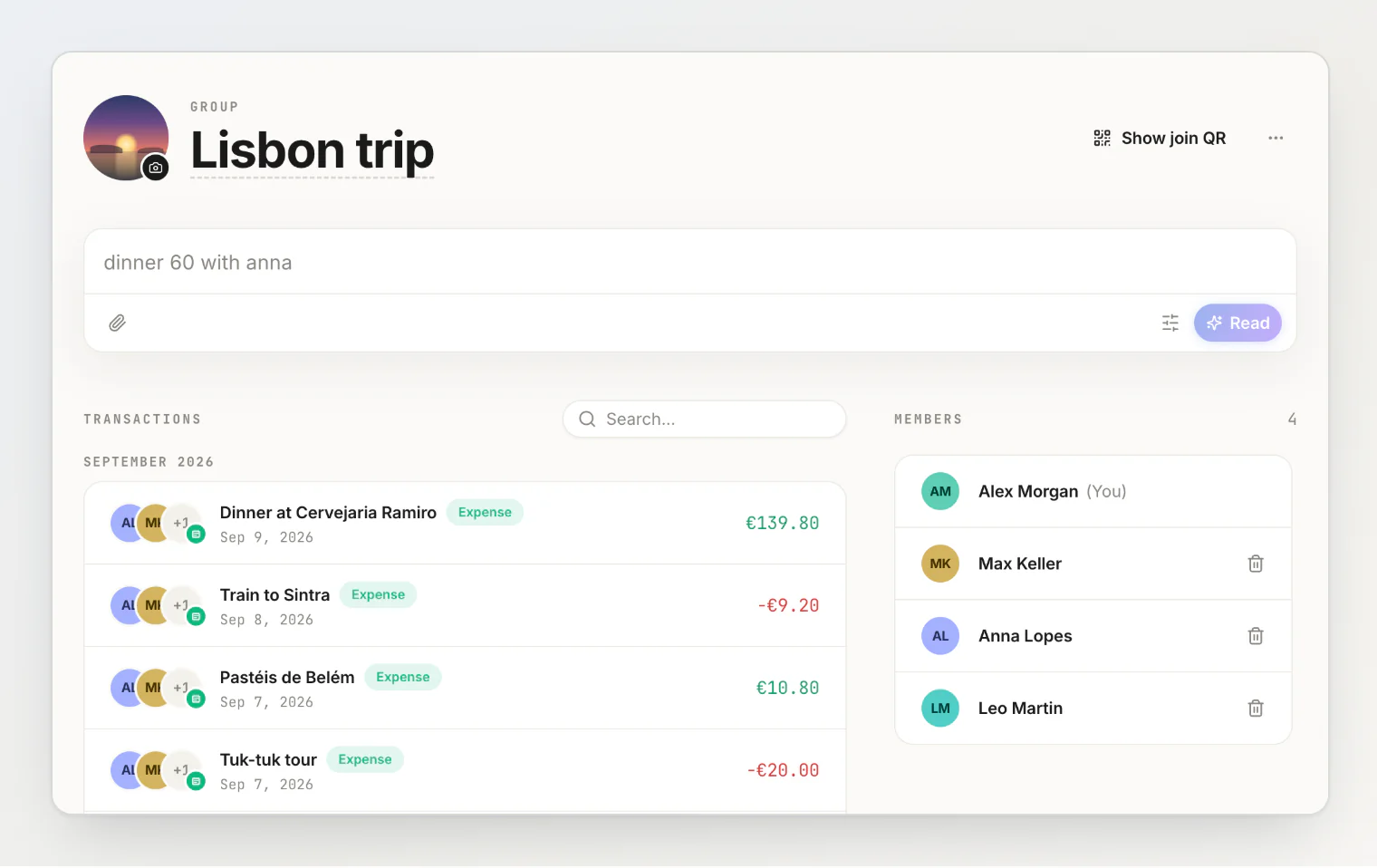
But the group holds no balance of its own; the money always settles person to person. It has no trip total either, because the list shows the transactions you were part of rather than everyone's. Archive the group after the trip and every transaction and balance survives untouched.
For the friend who won't install anything: add them as a placeholder and track normally. If they sign up later, a merge request — which they approve — links the placeholder's whole history to their real account.
Settling up
When someone pays you back, log a transfer and watch the balance resolve — down to "all square". If someone's balance has been sitting there a while, you can send them a reminder instead of composing an awkward message.
Two more tools help balances shrink on their own:
Multi-currency balances. Expenses record in the currency actually paid — USD, EUR, GBP and about 35 more, detected automatically from scanned receipts — and each person's balance is kept per currency, so €40 owed and £15 owed back stay two exact facts instead of one blurry estimate.
Debt simplification. When debts form a circle — you owe Alex, Alex owes Sam, Sam owes you — HiBill can cancel the loop. No money changes hands; a visible system entry records exactly what netted out, so the balance never changes mysteriously.
You can search your transactions by title when you only remember "that thing at the airport in June."
What HiBill deliberately doesn't do
No bank connection: HiBill is a memory tool, not a wallet, and transfers get logged when they happen between people, not when they clear at a bank. No group ledgers, for the reasons above. And no analytics on the contents of your transactions — your data isn't sold, and what you log stays yours.
What it costs
The free tier is free forever: unlimited transactions, 1 GB of storage for receipts and attachments, five AI receipt scans and 50 AI sentence reads a month, and room for 2,000 placeholder people and 200 groups. Pro, at $4.99 a month, raises the ceilings — 10 GB of storage, 100 scans and 1,000 sentence reads a month, 100 MB per file — for people who add or scan everything. No group plans, no per-seat math, no annual lock-in; a group full of friends costs nobody anything.
Continue reading
Two kinds of transaction is all you need — why expenses and transfers are the only two kinds of entry.
How to Log a Shared Expense in One Sentence (and Skip the Form) — the fast path in practice: type what happened, check it, add it.
HiBill Free vs Pro: What You Get, What's Metered, and When to Upgrade — the exact limits on each plan and when Pro is worth it.