Update, September 2026: Groups now also list the transactions you tag with them, so a trip reads as one timeline on its page. Everything below about balances is unchanged — a group still holds none, and there is still no trip total. See creating and using groups.
Seven people at the start of a trip. Nobody has everyone else's phone number, two of them just met, and somebody has to type six names into an app while everyone waits.
Groups solve exactly that.
A roster, not a ledger
A group is a named list of people. "Lisbon weekend". "Flat 4B". "Tuesday football".
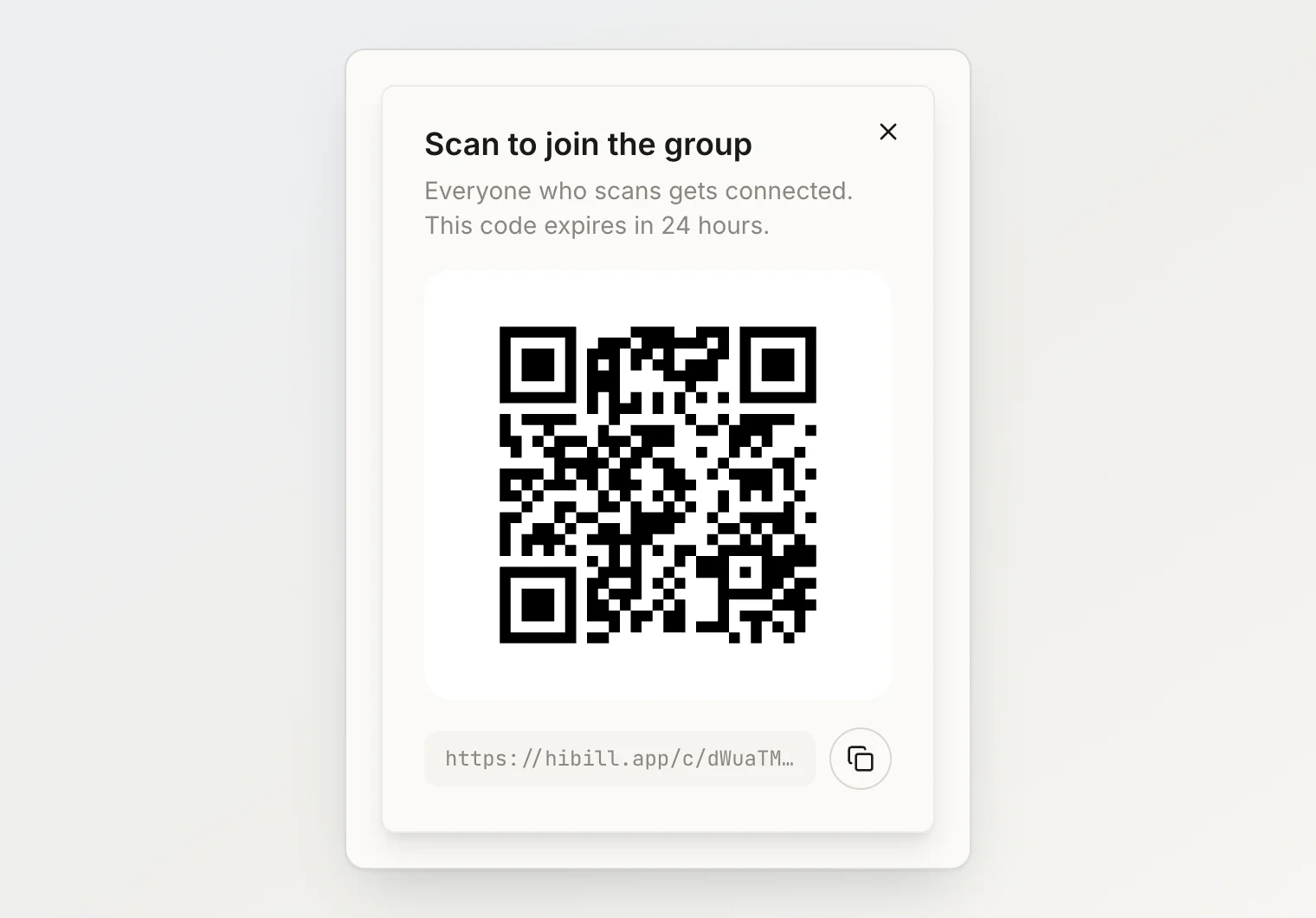
Open it, show the QR code, and everyone who scans it joins. The moment they do, they are connected to everyone else in the group — not just to you. Seven people become fully connected from one scan each, rather than twenty-one introductions.
Then, when you add a transaction, you drop the whole group onto it at once instead of picking names one at a time — and the transaction can carry the group's name, so the trip's expenses stay together on its page.
That is the whole of it. What makes it work is what it deliberately does not do:
A group holds no balance. It is not an account. Money never sits "in" it, and it settles nothing. Every balance a group helps you create lives between two people, exactly like every other balance in HiBill.
The practical consequence: you can archive a group and lose nothing. The trip ends, you tidy up, and every balance is still sitting between the pairs of people who actually owe each other.
Groups are disposable on purpose. Make one for a weekend. Make one for a single dinner. There is no reason to be precious about them — and if the group comes back next year, unarchive it.
How joining works
The join link is a QR code and a URL — whichever is easier in the moment. Across a table, the QR is faster. In a chat thread, send the link.
Links expire after 24 hours. This is short on purpose. A join link is a live invitation to connect to a group of real people, and its useful life is measured in minutes — the moment everyone is standing together. A link that stays valid forever is a link that gets forwarded into a group chat months later and lets a stranger connect to seven people.
If it expires before everyone joined, open a new code. It takes a tap.
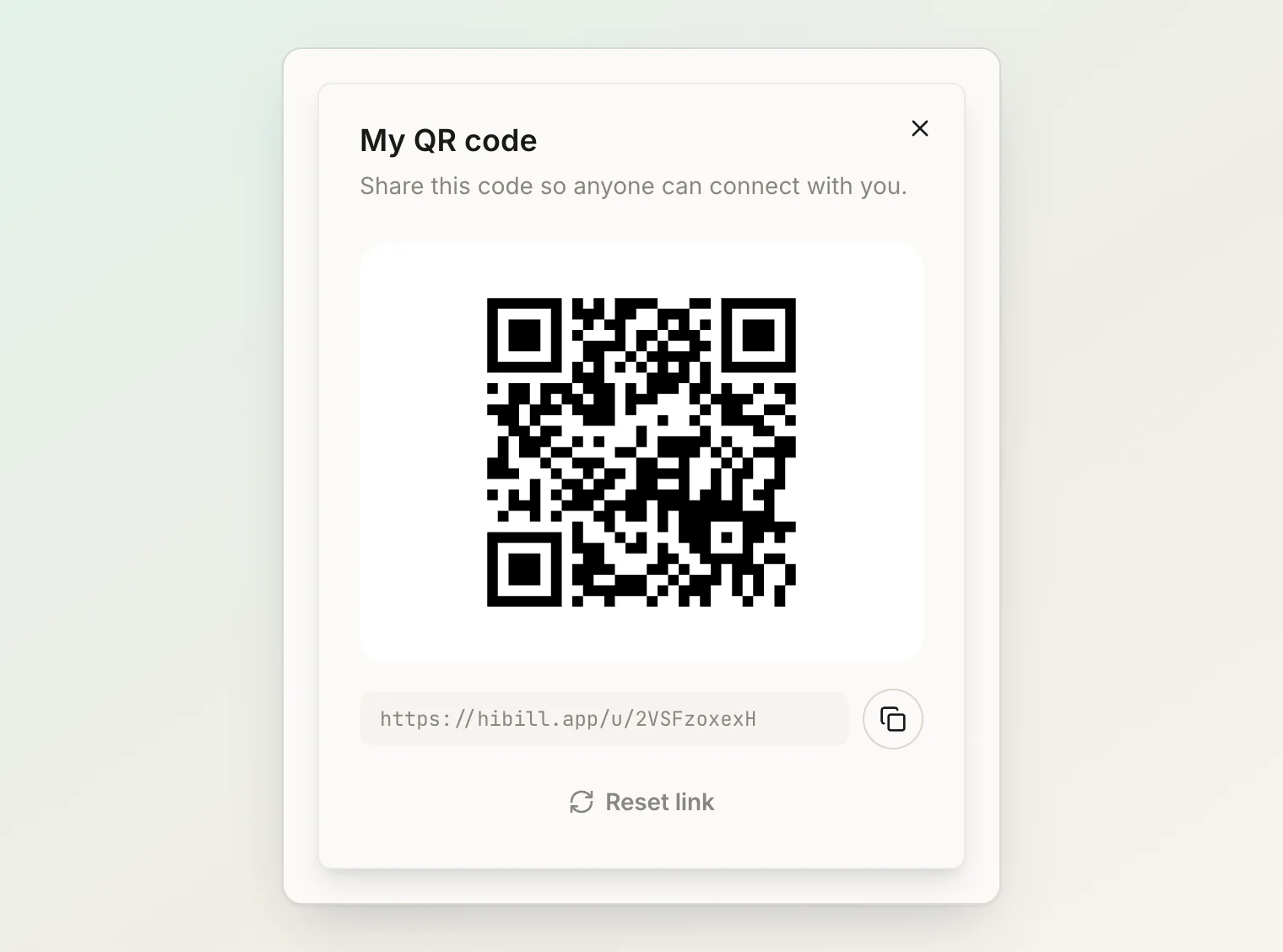
For connecting with one person rather than a group, there is a separate thing: your personal QR code, which is stable until you reset it. Different job, different lifetime.
The connection outlasts the group
When someone joins, what actually gets created is a relationship between them and each other member — the same kind of connection as adding a person by hand.
So the group is scaffolding. Once you have used it, you know those people; you can split with any of them individually, forever, whether or not the group is still active. Someone you met once on a trip to Lisbon is a person in your list, and if you end up sharing a taxi with them two years later, they are already there.
Groups are not required
Worth saying plainly, because the QR code makes the feature look central: most HiBill use does not involve a group at all.
For you and one other person — a partner, a flatmate, a sibling you keep lending money to — there is nothing to set up. Add them, split with them, settle when it suits. A group for two people is pure overhead.
Groups earn their place at a specific threshold: more than three people who do not all already know each other in the app. Below that, adding people directly is faster.
When you would use one
A trip. The canonical case: several people, one weekend, lots of shared costs.
A flat. Persistent, and the roster changes when someone moves out.
A recurring thing with a fluid cast — a regular football game, a book club that does dinner.
A one-off dinner with a big table, then archive it on the way home.
Groups are on every plan, including Free. There is no limit on how many people can be in one, and the cap on how many you can make is generous: 200 on Free and 2,000 on Pro.
Continue reading
How to split expenses on a group trip without ruining the trip — the whole trip, from the first booking to settling up at home.
How to Track Group Trip Expenses: A System That Survives the Trip — a habit for logging trip costs so nothing is left to reconstruct later.
Creating and using groups — the steps for making a group, sharing its QR code and archiving it.