Group trips do not fall apart at the settling-up stage. They fall apart on day one, when six people implicitly adopt six different definitions of what counts as a shared cost — and nobody notices until day six, when the person who booked the villa is €1,400 down and mildly furious.
The money problem on a group trip is not arithmetic. It is that a trip generates a hundred small transactions across several currencies, paid by whoever happened to be nearest the card machine, and then asks everyone to reconstruct it from memory a week later in a group chat.
Here is a system that works: what to agree before you go, how to record things without becoming the trip accountant, and how to settle at the end in a way nobody argues with. The basics underneath it, who took part, which split and one running balance, are in how to split expenses with friends.
Before you go
Agree what counts as shared
This is the one conversation that prevents almost all of the others. Ten minutes, before anyone books anything.
The categories that reliably cause trouble:
Accommodation. Usually shared — but not if one couple took the room with the balcony and the en suite. Rooms of different quality should cost different amounts, and that is much easier to say before the trip than after four nights in the box room.
Transport. Flights are almost always individual — people book at different times, from different cities, at wildly different prices. Ground transport is almost always shared.
Groceries. Shared, until someone buys their own oat milk and specialty coffee. Agree a threshold: shared basket, personal extras.
Restaurant meals. Decide whether you are splitting each bill or running a tab. On a week-long trip, running a tab and settling once is dramatically less work than fourteen separate reckonings.
Alcohol. The single most contested line item on any trip. If the group is mixed, split drinks among the drinkers rather than folding them into the food.
Activities. Individual by default. Not everyone is diving, and nobody should pay for a dive they skipped.
Tips, parking, tolls, the €4 for water. Shared, and not worth recording individually — but see the note on small amounts below.
Write the answers down somewhere all six people can see. The point is not bureaucracy; it is that "I assumed that was shared" becomes impossible to say on day six.
Decide who fronts the big costs, and acknowledge it
Somebody pays for the accommodation months in advance. That person is carrying a large interest-free loan for the group, which is fine, but it should be a decision rather than an accident.
Two things make it fairer. Split the large prepayment across several people rather than loading it all on one. And record it the day it is paid, not the day the trip starts — so the balance reflects reality from the moment the money leaves.
Connect everyone before you leave
The worst time to get six people onto a shared system is when three of them have no signal and one is asleep. Do it at the pre-trip dinner, or in the airport.
This is what groups are for in HiBill. Name one — "Lisbon weekend", "Split ski trip" — open the QR code, and everyone who scans it is connected to everyone else in one tap. Join links are live for 24 hours, which is enough for an airport gate and short enough that a screenshot forwarded three months later does not let a stranger in.
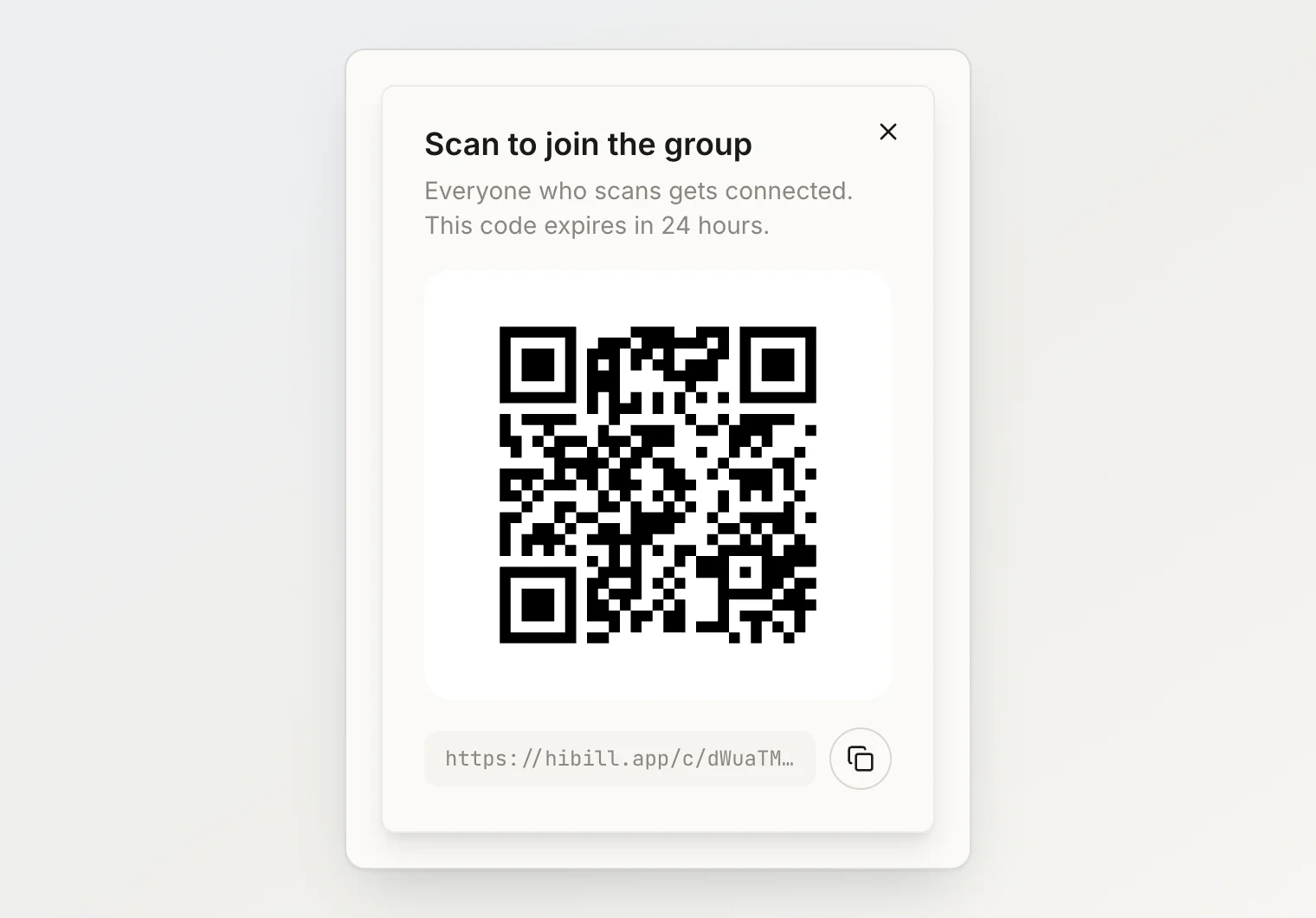
A group holds no balance of its own — its job is to save you from adding seven people one at a time, to let you drop all of them onto a transaction at once, and to gather the trip's transactions on one page as you tag them. We explained how joining works in one QR code, seven people, zero group chat, and how the tagging works in creating and using groups.
For anyone who has not signed up and is not going to before the flight, add them as a placeholder and split with them anyway. If they join later, merging the records keeps every transaction and the balance intact.
During the trip
Record it in the moment, or do not record it at all
This is the whole discipline. A transaction takes about fifteen seconds to record while you are standing outside the restaurant, and about four minutes to reconstruct a week later from a bank statement and an argument.
The trip accountant role — one person collecting receipts to sort out later — is a trap. It concentrates the work on someone who did not volunteer for it, and it means every number depends on one person's memory being better than everyone else's.
Practically: whoever paid records it, immediately, before putting their phone away.
Photograph the receipt
For anything itemized or in an unfamiliar currency, a photo is worth more than a typed total. It settles disputes, it survives fading thermal paper, and it means the line items are still available when you get to the end of the trip and someone asks what the €212 at the supermarket actually was.
Scanning a receipt reads the title, total, currency, date, line items, tax and tip into a review under the sentence field — fix anything it misread with a tap, and nothing is saved until you press Add. Free accounts get five scans a month and Pro gets 100, which matters if a two-week trip is your peak usage. You can also just attach the photo to the transaction and type the total yourself.
Do not itemize the small stuff
There is a threshold below which recording costs more than the error it prevents. For most groups it is somewhere around €5. Coffee, water, tolls, a parking meter — split evenly, do not itemize, do not photograph.
The exception is when small amounts are systematically uneven. Six coffees a day for one week is not a small amount, it is €60, and it is the kind of thing an even split quietly overcharges the tea drinker for.
Use the split method that matches the purchase
A trip generates genuinely different shapes of cost, and forcing them all through "divide by six" is what produces the arguments:
Equally for the villa, the taxi, the group dinner.
By amount or percentage when shares are uneven — the couple in the double room, the person joining for four of the seven nights.
By items for a supermarket run where half the basket is one person's dietary requirements.
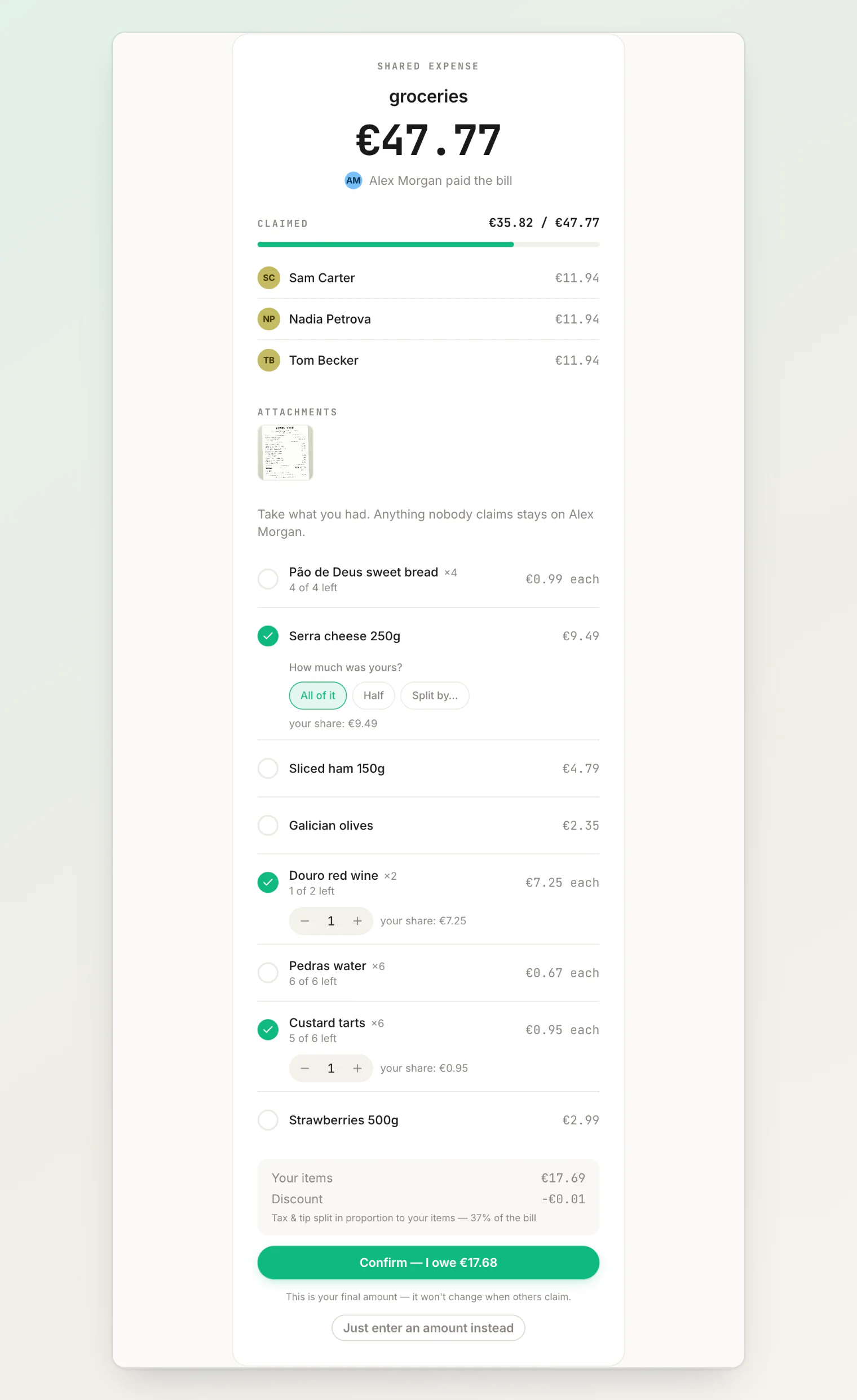
Open claim for the large restaurant bill nobody can reconstruct. Share the bill and let everyone claim what they had; whatever nobody claims stays with whoever paid, so the bill never gets stuck waiting on one straggler.
The full menu is in choosing a split method.
Handle currencies honestly
If you are crossing borders, you will end up with balances in several currencies, and the temptation is to collapse them into one number.
Resist it, and be wary of tools that do it for you. A converted total is a snapshot of an exchange rate at a moment nobody agreed to. Convert at booking-day rates and the person who settles in November pays a different amount than they owed in August. Convert at settlement-day rates and everyone's number quietly moved while they were not looking.
HiBill supports 38 currencies, set per transaction, and keeps balances separate per currency rather than converting them. If you owe someone €40 and £15, it says €40 and £15. The reasoning is in we refuse to convert your currencies, and there is a fuller treatment of the practical side in splitting expenses in multiple currencies.
The practical advice: settle each currency in its own currency where you can. If you must convert, do it once, at a rate everyone sees, recorded as its own transaction — so the conversion is a visible decision rather than an invisible drift.
Check the balances mid-trip
Not to settle. To catch errors while people still remember.
A five-minute look on day four catches the duplicate entry, the expense recorded against the wrong person, and the dinner nobody logged. The same check on day fourteen catches nothing, because nobody remembers Tuesday.
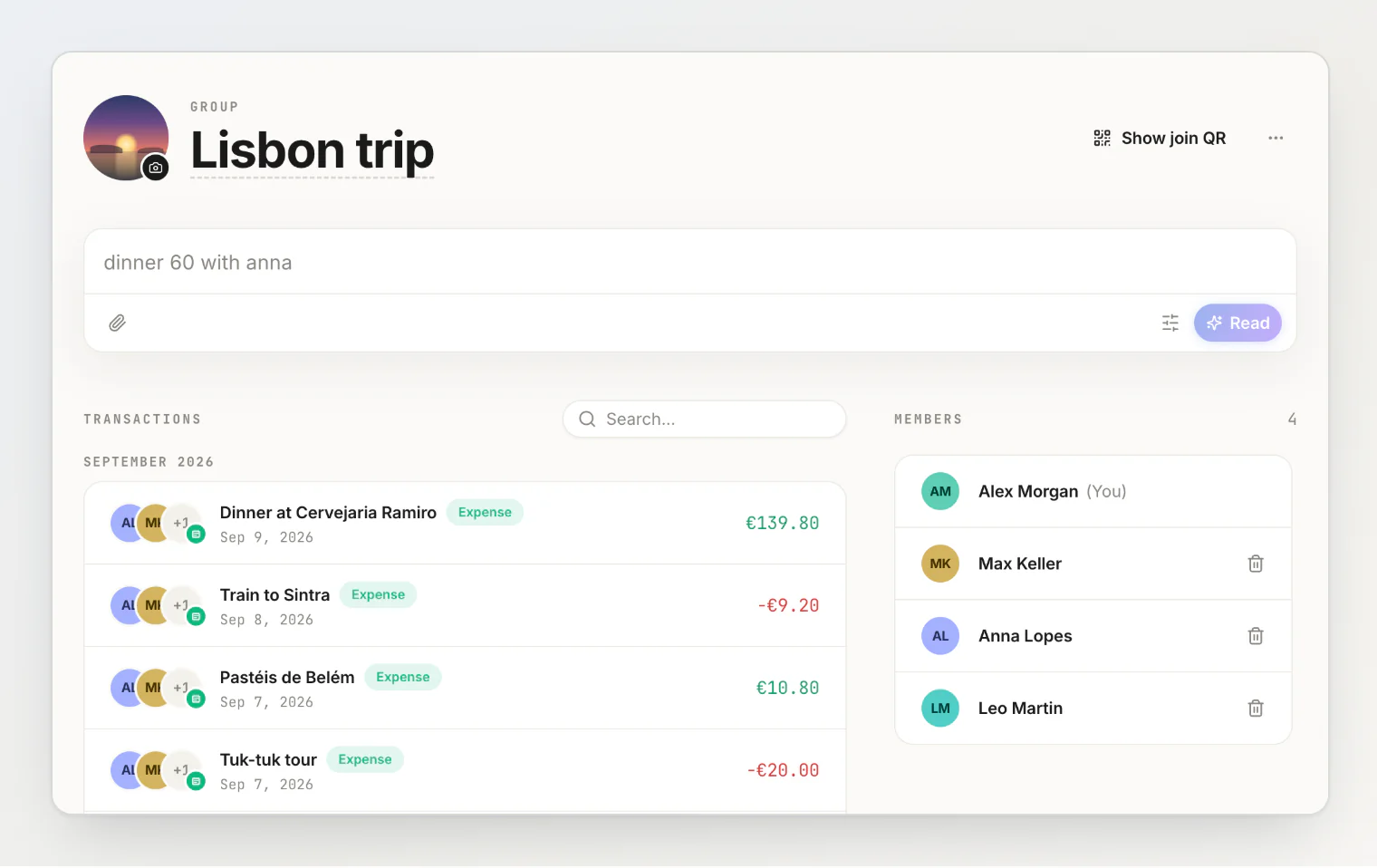
If you tagged the expenses with a group, its page is where to do that reading: the trip in one list, rather than filtered out of everything else you spent money on this month.
After the trip
Reconcile before you settle
Give everyone a day to look at the list before money moves. Most disputes are not disagreements about fairness — they are one person having recorded something twice, or having split a bill among five people when six ate.
If a balance looks wrong, there is usually a specific reason, and they are enumerated in why a balance looks wrong — a second currency hiding below the fold, an unclaimed share, an edit after the fact, a duplicate.
Simplify the loops before anyone transfers money
After a week, six people generate a mess of small mutual debts. You owe Ana €40, Ana owes Ben €35, Ben owes you €30. Paid out literally, that is three bank transfers to move almost nothing.
Simplifying debts collapses these loops into the smallest set of payments that leaves everyone in the same position. In HiBill it is one tap, and — importantly — it writes a visible Simplification entry rather than silently rewriting the numbers. No balance should move without a reason you can read afterwards.
Do this before settling. A group of six can routinely go from fourteen payments to four.
Settle, and allow partial payments
Settling up in HiBill is not a special ceremony. It is a transfer — money from one person to one person — that happens to bring a balance to zero. It sits in the same timeline as everything else, which means "did you pay me back?" is a question with an answer rather than a memory.
Partial settlements are fine and often better than waiting for someone to have the full amount. Someone paying €200 of a €350 balance today is €200 more settled than someone intending to pay €350 next month.
Nudge once, not repeatedly
Somebody always takes three weeks. A payment reminder is limited to one per person per day in HiBill, deliberately — a reminder system that can be used as a weapon stops being useful the first time somebody uses it as one.
A worked example
Six friends, five nights in Lisbon.
Before: they agree accommodation and ground transport are shared; flights, activities and personal shopping are individual; the two people in the larger room pay 25% of the accommodation each. They scan into a group at the airport.
Day 1: Maya recorded the €1,200 apartment in June when she paid it — split by percentage, 25/25/12.5/12.5/12.5/12.5. Airport transfer €60, split evenly. Supermarket run €94, split evenly except the €22 of gluten-free items assigned to one person.
Days 2–5: each dinner recorded by whoever paid, most split evenly. The big Thursday dinner — nine people, two tables, an hour of confusion — gets shared as an open split, and seven of the other eight claim within an hour. The eighth never does, so his share stays with the payer, and she chases him directly rather than the bill hanging unresolved.
Day 6: they simplify. Fourteen outstanding debts collapse to four payments. Three people transfer money that evening; one settles half now and half at the end of the month.
Nobody built a spreadsheet. Nobody was the trip accountant. The whole thing took about four minutes of anyone's attention per day.
Frequently asked questions
How do you split accommodation when rooms are different sizes? By percentage, agreed before booking. A common convention is that the master bedroom pays 20–30% more than the smaller rooms, and anyone on a sofa bed pays materially less. The exact number matters far less than agreeing it while everyone still has the option to swap.
Should flights be split? Almost never. People book from different cities at different times for different prices, and there is no fair basis for averaging them. The exception is a chartered vehicle or a group booking made as one purchase — that is a shared cost like any other.
What if someone joins for only part of the trip? Give them a share of the costs that overlap their stay and nothing else. Accommodation by nights present, food and transport for the days they were there. This is much easier if you record costs as they happen with dates attached, rather than tallying totals at the end.
Who should pay for the person organising the trip? Nobody, usually — organising is a contribution of time, not a claim on money, and turning it into a discount tends to create more resentment than it resolves. If the group wants to acknowledge it, buy them dinner and record it as a shared expense rather than adjusting the split.
What if someone refuses to pay? Separate the record from the collection. Keep the transaction accurate regardless of whether it is ever settled — an accurate ledger with an outstanding balance is a much better position than a deleted record and a grudge. Send one reminder. After that it is a conversation, not a notification.
Do we all need the same app? No. You can add people who have not signed up as placeholders and split with them immediately, or share a single transaction by public link that anyone can open without an account.
The short version
Agree what is shared before you go. Record in the moment. Do not appoint a trip accountant. Keep currencies separate. Simplify the loops before anyone transfers money. Nudge once.
The goal is not perfect accounting. It is that on the last night nobody is doing arithmetic, and in November nobody is still owed.
Continue reading
How to Track Group Trip Expenses: A System That Survives the Trip — the tracking side in depth: set up before departure, record as you go, settle once at the end.
Splitting expenses in multiple currencies without starting an argument — which rate to use when you must convert, and how to settle each currency cleanly.
Debt Simplification Explained: How Circular Debts Between Friends Cancel Out — why a loop of trip debts collapses into a few payments, with a worked example.