Two people go to Tokyo. One pays ¥18,000 for the hotel; the other pays €62 for the airport train back in Europe. A week later the app says one of them owes the other €47.13.
Where did that number come from? Which day's rate? Does it still mean the same thing next Tuesday? And if they settle in euros, has anyone actually been made whole?
Multi-currency splitting is the part of shared expenses that quietly produces the most confusion, because the errors are invisible. Nobody argues about a rate they never saw. They just notice, vaguely, that the number moved.
The core problem: a converted balance is a snapshot
The moment you convert a foreign-currency expense into a home currency and store the result, you have baked in an exchange rate. That rate is a fact about one moment. The debt outlives the moment.
Three things go wrong from there.
The rate moves and the debt does not. You record a ¥18,000 hotel at 160 JPY/EUR — €112.50. You settle four months later at 172 — the same ¥18,000 is now €104.65. Somebody is €8 out. Neither person did anything wrong; the number just aged.
Which rate, decided by whom. Mid-market? Your bank's? The card network's, with its 1–3% spread? These differ by several percent, which on a two-week trip is real money. If the tool picked silently, nobody agreed to the choice.
Re-conversion compounds. Convert JPY to EUR to record it, then convert EUR to GBP to settle with a British friend, and you have applied two spreads to a number that started as a single clean yen figure. Each hop loses a little, always in the same direction.
None of this is catastrophic on one dinner. Across a trip it accumulates, and — worse — it accumulates invisibly, which means the first anyone notices is when a balance does not match what they remember agreeing to.
The fix: record the currency that was actually spent
The reliable rule, and it is simpler than it sounds:
Record every expense in the currency it was paid in. Keep balances separate per currency. Convert only when money actually moves, once, as a visible decision.
A ¥18,000 hotel is a ¥18,000 hotel. It does not become €112.50 until somebody actually exchanges money, and until then, storing it as €112.50 is storing an opinion as if it were a fact.
This is how HiBill works, deliberately. There are 38 currencies, set per transaction, and balances stay separate per currency rather than being collapsed into one. If you owe someone €40 and £15, it says €40 and £15 — two lines, not one number that is secretly a guess. We wrote about the reasoning in we refuse to convert your currencies.
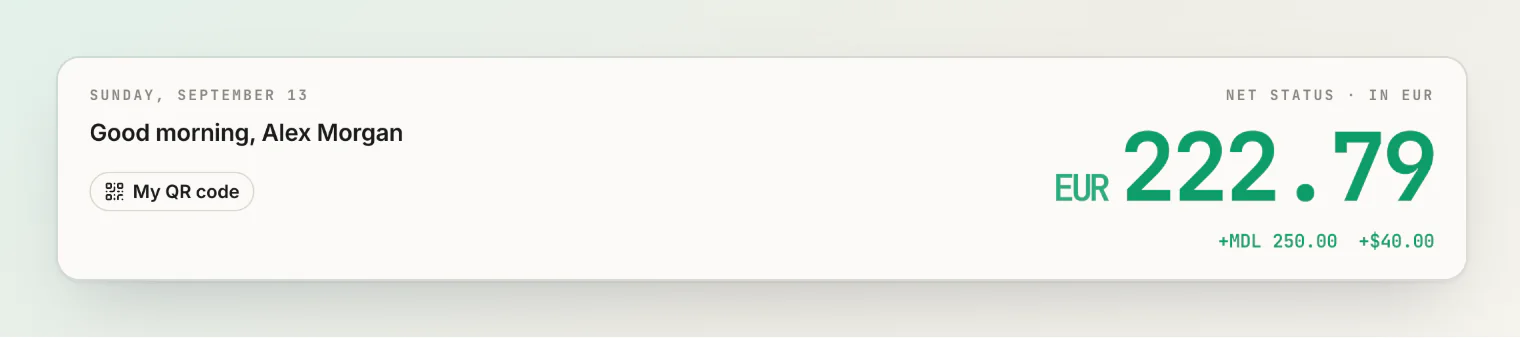
The immediate objection is that two lines are less convenient than one. That is true, and it is the point. The single number was never more convenient — it was just less honest about the work it was hiding, and the work reappears the moment somebody disputes it.
When you do have to convert
Sometimes there is no way around it. Someone owes you ¥9,000 and has no yen, no Japanese account, and no intention of ever having either.
Convert once, at settlement, as its own transaction
Do not retroactively rewrite the original expense. The dinner was in yen; it stays in yen. What you are doing is a separate act: agreeing to accept euros in discharge of a yen debt, at a rate you both looked at.
Record it that way — a transfer of the ¥9,000 the balance shows, with a note saying it was paid in euros and at what rate. A transfer carries one currency, so a euro transfer would leave the yen balance open. The original record stays true, and the conversion is a visible decision with a date on it rather than an invisible adjustment.
Pick the rate before you need it
Agree the convention at the start of the trip, when nobody knows which way it will go. Any of these is fine; deciding after the fact is not:
Mid-market rate on the settlement date. Neutral, easy to look up, splits the spread evenly.
Mid-market on the transaction date. Fairest to whoever fronted the money, since it matches what they actually gave up.
The payer's actual card rate, from their statement. The most accurate reflection of real cost, but it requires them to share a statement line and it can look self-serving even when it is not.
The reason to choose in advance is straightforward: after the fact, every choice benefits somebody, and whoever proposes one looks like they are proposing it for that reason.
Round in the debtor's favour and stop thinking about it
The difference between rate conventions on a €200 debt is typically €2 to €6. That is not worth a conversation with a friend. Round generously, settle, move on. The cost of precision here exceeds its value almost every time.
Card fees, and the trap of DCC
An underrated distortion. If one person paid in Thailand on a card with a 2.75% foreign transaction fee and another paid on a fee-free card, they did not incur the same cost for the same purchase — even though the receipts are identical.
Two reasonable approaches. Ignore it, treating the fee as a personal cost of the card you chose — simplest, and defensible. Or share it, adding the fee to the expense as part of the true cost of the group purchase. Either is fine as a policy. What is not fine is having no policy, because it means whoever has the worse card is silently subsidising everyone else all trip.
The one to actively avoid is dynamic currency conversion. When a terminal abroad asks whether you would like to pay in your home currency, it is offering to convert at a rate typically 3–7% worse than your card's. Always decline and pay in the local currency.
DCC also corrupts the record: the receipt shows your home currency, so the group's ledger captures the marked-up number instead of the local-currency truth. Whoever tapped their card absorbed a bad rate on everyone's behalf, and the ledger cannot see it.
Settling across currencies
Settle each currency in its own currency wherever you can. If both of you have euro accounts and the debt is in euros, that is a clean transfer with no rate involved. Do that first, for every currency where it is possible.
Then handle the leftovers. Usually one or two currencies where one party has no practical way to pay. Convert those, once, at the agreed rate, and record a transfer in each of those currencies for what its balance shows, with the rate written down.
Simplify first, then settle. With three or more people across two currencies, you can generate a startling number of small mutual debts. Simplifying collapses the loops within each currency into the fewest payments — and because it works per currency, it does not introduce a conversion you did not ask for. It writes a visible Simplification entry, so no balance moves without a reason you can read afterwards.
Do not net across currencies. If you owe someone €30 and they owe you £25, resist the urge to call it even. Those are two debts, and the moment you net them you have implicitly picked a rate. Settle both, or convert deliberately.
Practical habits
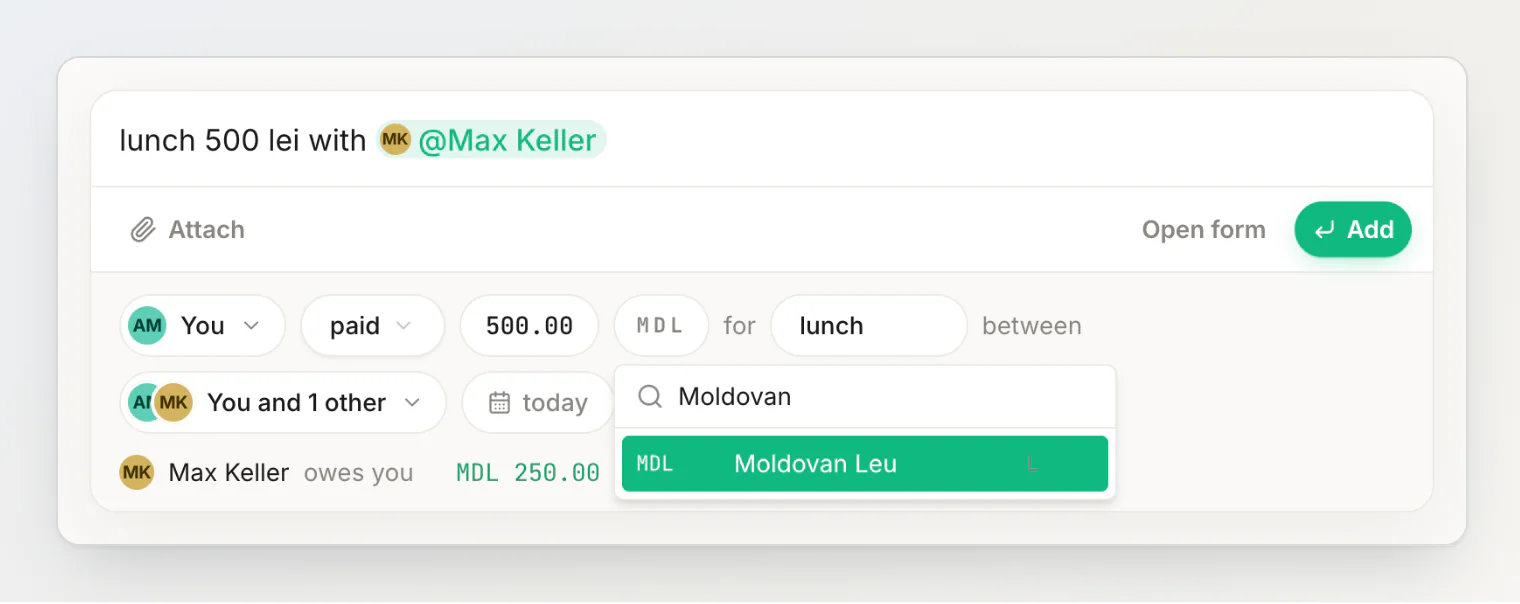
Set the currency at the moment of recording. Currency is a property of a transaction, not of an account, and the time to get it right is while you are standing outside the restaurant. In HiBill it is per-transaction for exactly this reason. Type lunch 500 lei with max and the review shows the currency it read as its own chip — here MDL — and tapping the chip opens a searchable list if it picked the wrong one.
Photograph receipts abroad. The currency, the local tax treatment, and the pre-DCC amount are all on the paper and all easy to misremember three days later. Scanning pulls the currency off the receipt along with the total, date and line items.
Watch for the currency you forgot. The most common cause of a balance that looks wrong is a second currency sitting below the fold — you are looking at a €0 line and there is a ₺400 line underneath it. This and the other usual suspects are enumerated in why a balance looks wrong.
Check balances mid-trip. A wrong currency caught on day three is a two-second edit. Caught on day thirty, it is an argument about what a receipt in a language nobody reads actually said.
A worked example
Four friends, ten days, Japan and South Korea.
They agree upfront: everything recorded in the currency paid, no conversions during the trip, settle at mid-market on the settlement date, foreign transaction fees are personal, always decline DCC.
By day ten they have JPY balances between all four, KRW balances between three, and a couple of EUR expenses from the flights and the pre-booked rail pass.
At the end: they simplify each currency separately — eleven outstanding debts become five payments. Two of the four have yen from an ATM withdrawal and settle in yen directly. The other two have neither yen nor won, so they convert both balances at one agreed mid-market rate, recorded as two transfers — one in yen, one in won — with the rate noted in each.
Total conversions across the trip: two. Total arguments: none. The ledger still says, correctly, what every expense cost in the currency it was paid in — yen as yen, won as won.
Frequently asked questions
What exchange rate should I use to split a foreign expense? Ideally none — record it in the currency it was paid in. When you must convert to settle, mid-market on the settlement date is the easiest convention to agree and the hardest to argue is biased. Agree it before the trip.
Why does my balance keep changing if nobody added anything? Because something is converting it at a live rate. A stored balance in a fixed currency does not move on its own. If yours does, the tool is re-converting on every view, and the number you saw last week was never a commitment.
Should I convert everything to one currency to keep it simple? It looks simpler and is not. You trade a small amount of visual tidiness for a permanently uncertain number, plus a rate choice nobody agreed to. Two honest lines beat one convenient guess — particularly when someone eventually queries it.
How do I split a bill paid in a currency none of us live in? Exactly the same way: record it in the currency of the bill, split it there, and let the balance sit in that currency until settlement. Where everyone lives is a fact about settlement, not about the expense.
What about crypto, or a wallet balance? Same principle, more so. Volatile units make the drift dramatic rather than subtle — a debt recorded in a volatile unit can double or halve before it is paid. If you must, agree the settlement unit at the time of the expense and record the debt in that.
How many currencies does HiBill support? 38, set per transaction, with balances kept separate per currency. The details are in working with multiple currencies.
The short version
Record in the currency spent. Keep balances separate. Decline DCC. Agree a rate convention before you need one. Convert once, at settlement, as a visible transaction with the rate written down.
The goal is that every number in your ledger is a fact somebody can check, rather than a conversion nobody watched happen.
Continue reading
How to split expenses on a group trip without ruining the trip — the broader guide to trip logistics, from the first booking to the last transfer.
We refuse to convert your currencies — why HiBill keeps every balance in the currency it was spent in.
How to Track Group Trip Expenses: A System That Survives the Trip — the habits that keep a trip's records straight while you travel.