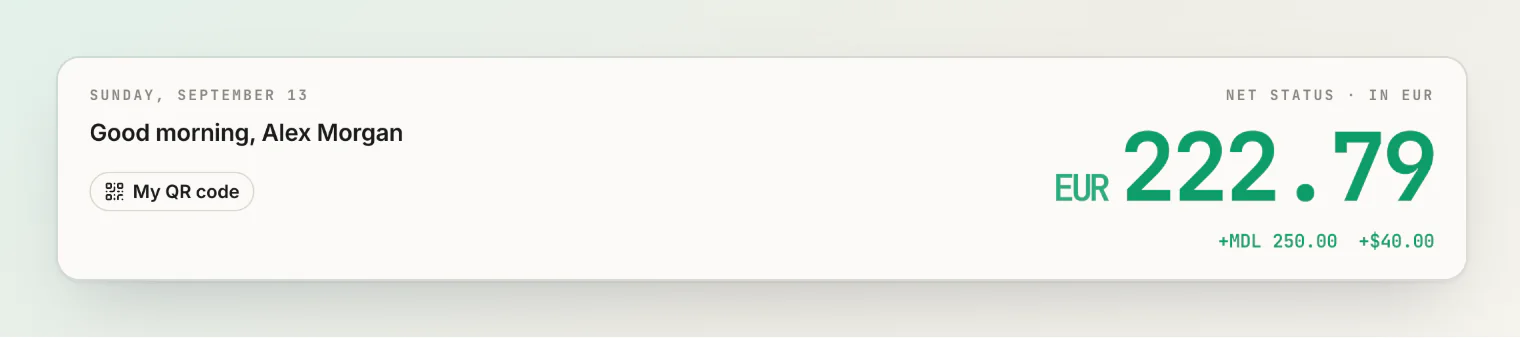
A balance in HiBill answers one question: between me and this one person, in this one currency, who is ahead right now?
Always between two people
There is no group balance, no shared pot, no account that holds money. Every balance is pairwise.
Open a person and you see the two-person ledger — every transaction you both touched, and the resulting figure. If six people were on a trip, that trip produced balances between each pair, and you see the ones involving you.
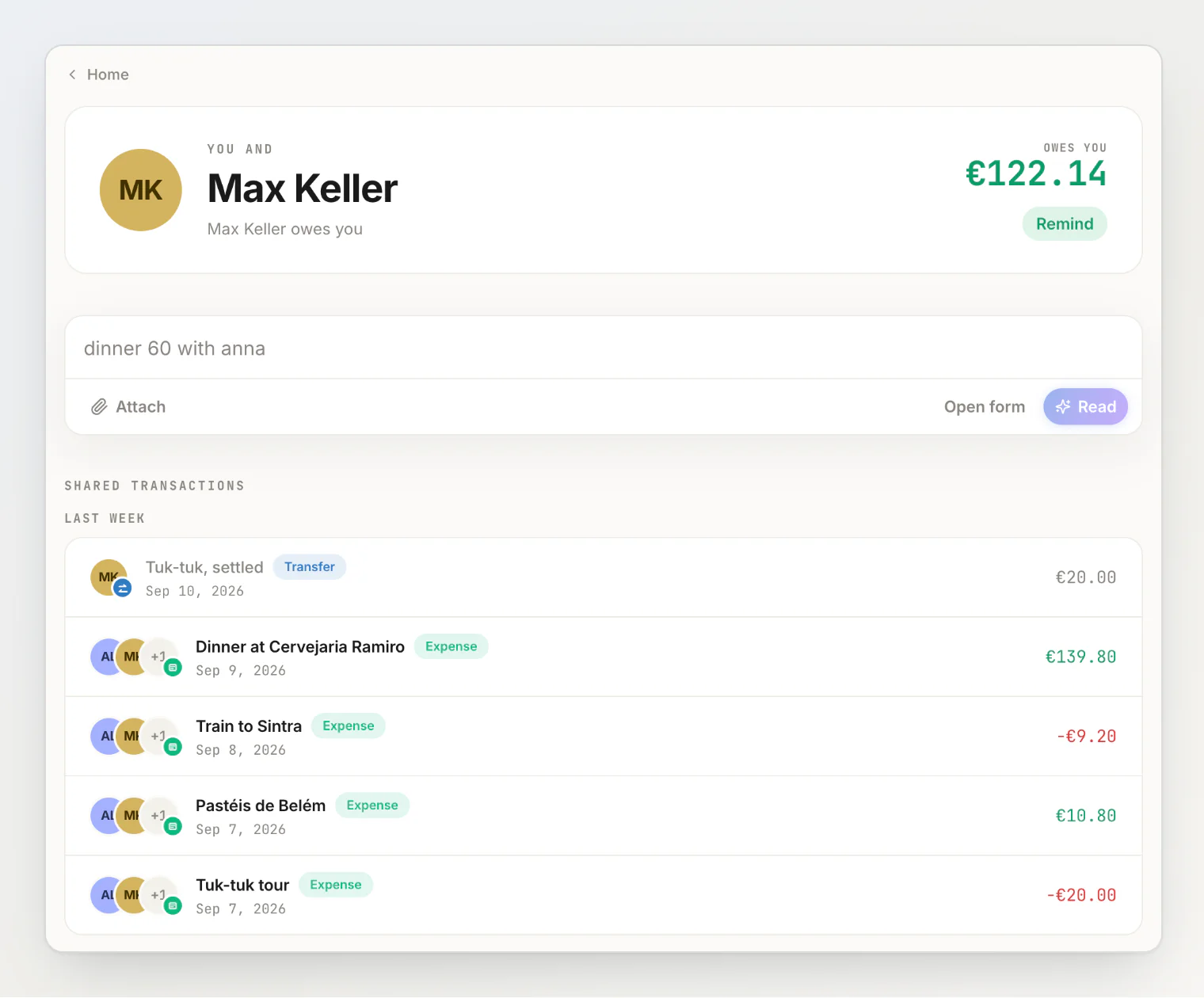
This is why groups hold no balance. A group connects people; the money settles one-to-one.
Always one currency
Balances never mix currencies. If you owe someone in euros and in pounds, you see two figures:
You owe Marco €40.00 £15.00
HiBill will not convert these into one number, because doing so requires choosing an exchange rate that neither of you agreed to. See working with multiple currencies.
What moves a balance
Only three things:
An expense where you and that person were both involved — one of you paid, the other owes a share.
A transfer between the two of you, in either direction.
A simplification, written when you run Simplify debts and a debt loop collapses. These are always visible in the timeline and labelled.
That is the complete list. Nothing else changes a balance. No fees, no rounding drift, no background adjustments.
Being involved without being affected
You can appear on a transaction without your balance changing. If you paid for exactly your own share of something — you covered €20 and your share was €20 — you are on the expense, but nothing is owed either way.
This is normal and worth knowing when a transaction shows up in your feed with no balance change attached.
Reading the sign
The app states the direction in words rather than making you interpret a plus or minus:
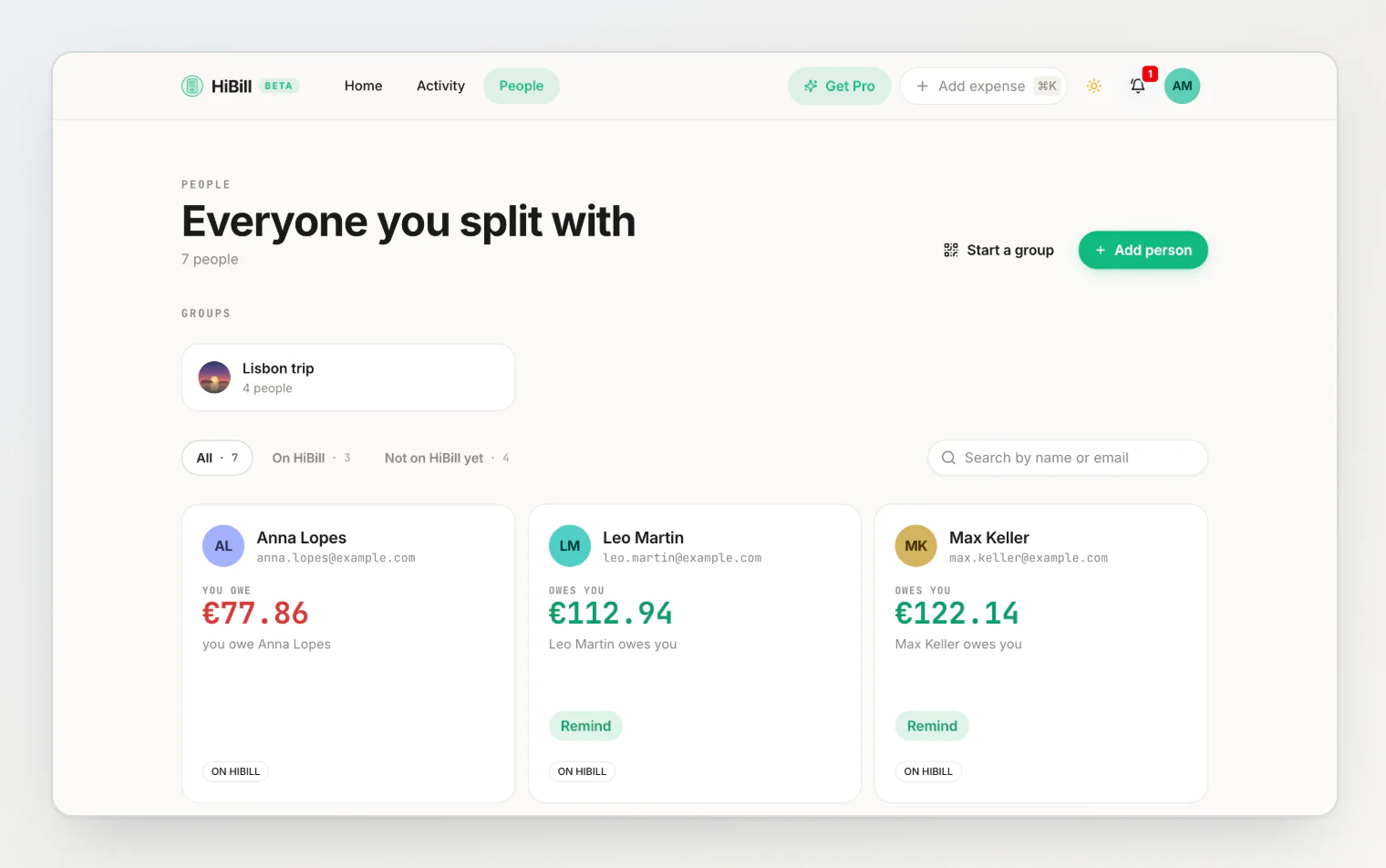
You owe Marco €40.00 — you are behind; you pay to square up.
Marco owes you €40.00 — you are ahead.
Settled up — the balance is zero. The history is still there.
Settled does not mean deleted
Bringing a balance to zero does not clear the history. Every transaction stays in the timeline, and the balance simply reads as settled. You can scroll back through months of a two-person ledger that has been squared off a dozen times.
Why the balance might not be what you expect
A few common causes:
A second currency. Check whether there is another figure below the one you are looking at.
A simplification. Look for a labelled Simplification entry in the timeline — a debt loop was collapsed.
An open split with unclaimed shares. On an open split, anything nobody claims stays with the payer, so the balance may be smaller than the full bill suggests.
Someone edited a transaction. Edits recalculate balances and are recorded in the transaction's own activity log.
If it still looks wrong, open the person and read the timeline top to bottom — every change has a visible entry behind it. There is a full walkthrough in why a balance looks wrong.
Continue reading
Settling up and payment reminders — bring a balance down, in full or in part, and nudge someone who owes you.
How debt simplification works — how a debt loop collapses into fewer payments, with every change visible.
5 Ways to Keep Track of Who Owes You Money (and Which One Holds Up) — why a per-person ledger holds up where notes and group chats fall apart.