Somebody owes you €80. It has been six weeks. You have thought about it perhaps twenty times, drafted a message twice, and sent nothing.
This is close to universal. Surveys of lending between friends consistently find that most people would rather write off the money than ask for it a second time — and that a meaningful share of friendships have been damaged by an unpaid debt that was, in absolute terms, small.
The strange part is that the debtor usually is not avoiding you. Most unpaid debts between friends are administrative, not moral: they forgot, they meant to do it on payday, they were not sure of the exact figure and never resolved the uncertainty. But from the outside, forgetfulness and avoidance look identical — and the longer nobody says anything, the more the silence starts to feel like evidence.
Why the ask is so hard
Worth understanding, because the difficulty is structural rather than a personal failing.
Money moves a friendship into a different register. Friendships run on informal reciprocity — you get this round, I got the last one, nobody is counting. An explicit debt with a number attached is a different kind of relationship, and asking forces a switch between the two mid-conversation.
Asking feels like an accusation. "Can you pay me back?" contains an implicit "you have not paid me back", which contains an implicit "you were going to forget". None of that is intended and all of it is audible.
Uncertainty compounds the delay. If you are not completely sure whether it was €80 or €75, or whether they already covered part of it with that taxi, you cannot ask cleanly — and rather than ask a vague question, most people ask nothing.
Time makes it worse, in both directions. Every week that passes raises the stakes of raising it, because now you are also explaining why you left it so long. The debtor's own embarrassment grows in parallel, which makes them less likely to bring it up, not more.
That last dynamic is the important one. Both people are waiting for the other to make it not-awkward, and the waiting is what makes it awkward.
Before you ask: get the number right
Half of these conversations go badly for a reason that has nothing to do with the relationship. You say €80, they remember €65, and now the conversation is about whose memory is better rather than about a payment.
Sort this out before you open your mouth. What was the expense, what was their share, has anything already been paid against it, is there anything you owe them that nets off.
If you have a record, this takes ten seconds. If you do not, reconstruct it honestly and be prepared to give the benefit of the doubt on anything ambiguous — a €10 concession is cheap compared to a dispute.
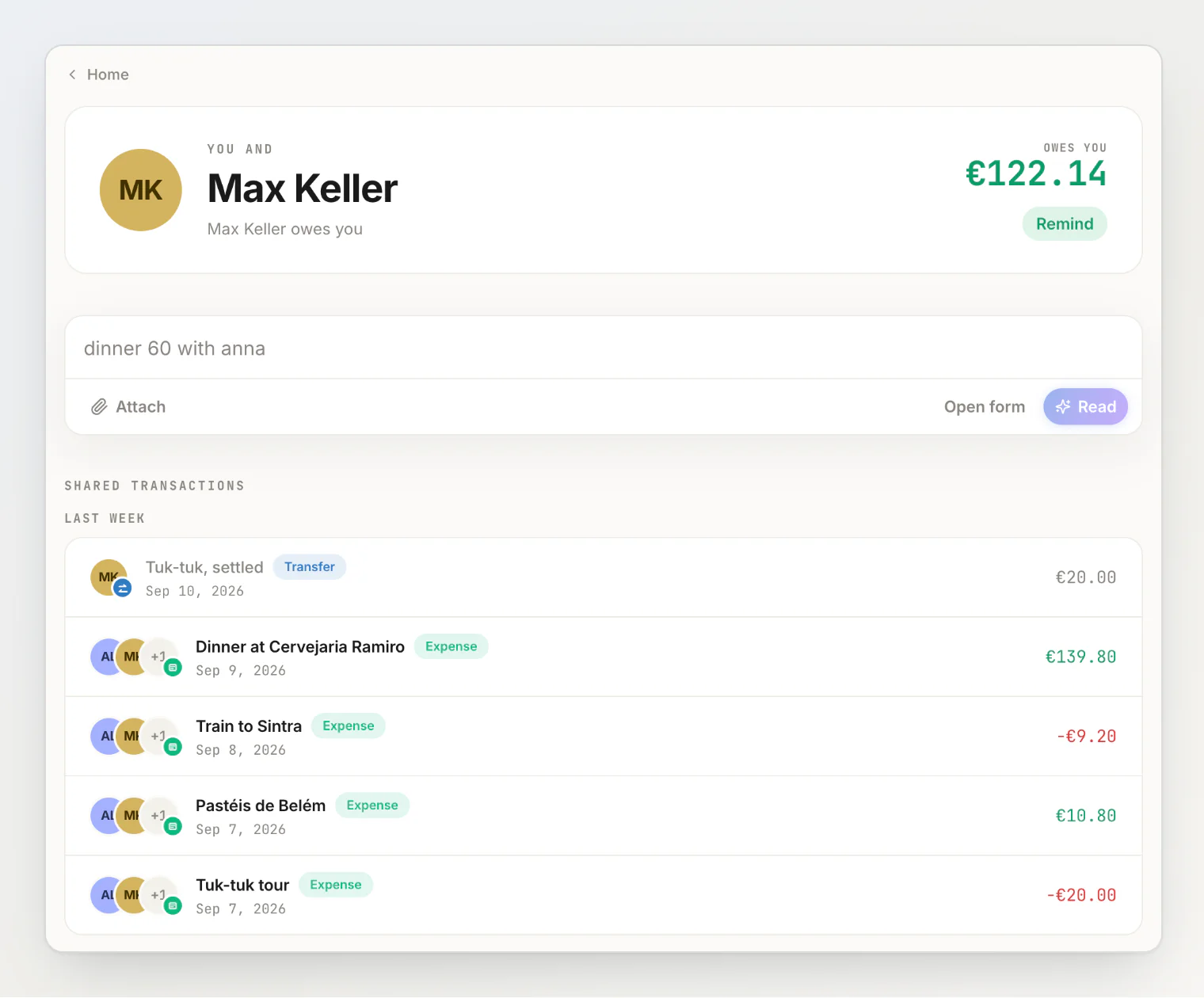
This is the strongest practical argument for recording shared costs as they happen rather than remembering them. In HiBill a balance is always between two people, in one currency: you open a person and see the entire two-person history — every expense, every payment, what it comes to right now. The number is not your claim against their claim. It is just what the record says, which is a much easier thing to send someone.
What to actually say
The mechanics matter more than people expect. Four things make the ask land well.
Be specific
Vague asks are easy to defer and easy to misremember. "You still owe me for a few things" invites a shrug. "You owe me €80 from the Barcelona flights" invites a payment.
Name the amount and what it was for. If you can send the actual record — the transaction, the receipt — do that instead of describing it. If they are on HiBill, point them to the transaction — it sits in their two-person ledger too; if they are not, send a photo of the receipt. Either turns "I think it was about eighty" into a thing they can look at. (Sharing a bill by public link is a different tool: it opens the split so people can claim their own share.)
Give them an easy exit
The most effective framing gives the other person a way to not have been at fault. It costs you nothing and it removes the defensiveness that turns a two-message exchange into a bad afternoon.
Hey — think the €80 from the flights is still outstanding? No rush, just tidying up my bank stuff.
The "no rush" is doing real work here. It signals this is administrative rather than a grievance, which is almost always true and rarely comes across.
Make paying trivially easy
Every extra step is an opportunity to defer. Include your payment details in the same message. Do not make someone search for an IBAN.
Half of all unpaid small debts are unpaid because paying required three actions and the person was on a train.
Ask once, then wait
One clear message. Then leave it a week or two before anything else. A follow-up after three days reads as chasing, and chasing changes the tone of the relationship far more than the debt does.
If you use a tool for it, this should be built in. HiBill limits payment reminders to one per person per day, deliberately — a nudge that can be used as a weapon stops being a nudge.
Some scripts
Recent and small.
Hey! Can you send me the €24 for dinner when you get a sec? No rush.
Older, and you feel awkward about the delay.
This is well overdue on my side to mention — is the €80 from the flights still outstanding? Completely forgot about it until I was going through my account.
Taking a share of the lateness onto yourself is not dishonest; you did also leave it. It makes the whole thing symmetrical.
They might genuinely not know.
Not sure if this ever got sorted — I've got €80 outstanding from the Barcelona trip on my side. Does that match what you have?
Asking whether it matches is the single most useful move available. It converts a demand into a reconciliation, and if their number is different, you find out now instead of mid-argument.
A larger amount, or a real loan.
Wanted to check in about the €600 — is it still workable to sort it this month, or would it help to split it over a couple of payments?
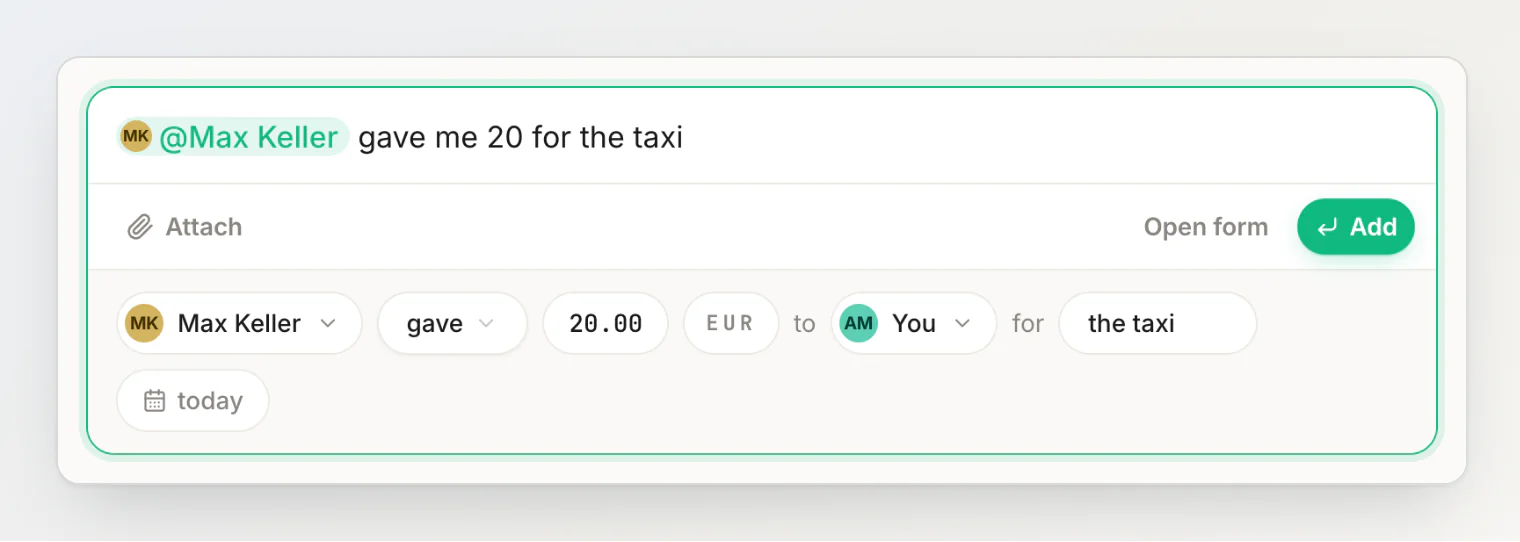
Offering the instalment first removes the need for them to admit they cannot pay. Partial payments are usually much better than waiting for the full amount to be possible: someone paying €200 of €600 today is €200 more settled than someone intending to pay €600 eventually. Settling in HiBill is just a transfer that moves the balance, and it does not have to close it. When a payment arrives, type it the way you would say it — Max gave me 20 for the taxi — and the review reads it as money coming your way before you add it.
They said they would pay and did not.
Hey, did the transfer go through your end? Nothing showing on mine — might have bounced.
Assume a technical failure. It is sometimes true, and when it is not, it hands them a graceful way to fix it today.
When they do not pay
Second ask, after two weeks
Direct, still warm, no accumulated grievance in it.
Hey — still nothing on the €80. Can you let me know when you're able to sort it?
Ask for information rather than money. "When are you able to" is much harder to leave unanswered than "can you pay", and the answer tells you which situation you are in.
If they cannot pay
Sometimes the answer is that they do not have it. This is a different problem from avoidance, and the response should be different.
Offer a schedule — €20 a month for four months turns an impossible number into a possible one, and gives both of you something to point at. Record the payments as they come in so the shrinking balance is visible to both of you. Watching a number go down is one of the few things that reliably keeps this kind of arrangement alive.
And be honest with yourself about the ceiling. If they cannot pay and the amount is small, forgiving it deliberately is a legitimate option — and it is much better than a slow default, because you choose it and it ends. Say it once, clearly, and never bring it up again. A forgiven debt you keep mentioning is not forgiven.
If they will not pay
Rare, but it happens. At this point the money and the friendship have become the same question and you have to answer it.
Say it plainly, once: this matters to me, it is affecting how I feel about things, I would like it resolved. No ultimatum, no third parties, no group chat.
If that does not work, decide what the relationship is worth and act accordingly. The one thing not to do is stay in the loop indefinitely — repeated unanswered asks corrode far more than a written-off €80 ever would.
Keep the record accurate either way. Do not delete the transaction to make the feeling go away. An honest ledger with an outstanding balance is a much better position than a deleted record and a grudge — and if they do come back in six months wanting to sort it out, the number is still there.
How to stop needing to ask
The best version of this conversation is the one that never has to happen, and that is mostly a matter of a few habits.
Record it at the time. Fifteen seconds standing outside the restaurant beats a memory reconstruction six weeks later, and it removes the uncertainty that stops people asking. Recording your first shared bill walks through it end to end.
Make it mutual. A shared record where both people can see the same numbers is not surveillance, it is the opposite — nobody has to keep a private tally, and neither of you is the one keeping score. Both parties seeing the same ledger is why inviting someone is worth the thirty seconds.
Settle small and often. A €40 balance settled monthly never becomes a €600 balance nobody wants to discuss. Frequency is doing more work here than any particular technique.
Let people claim their own share. For a big group bill, the chasing problem is largely self-inflicted — one person reconstructs what nine people ate and then pursues them individually. Share the bill and let each person claim what they had. Whatever nobody claims stays with whoever paid, so nothing hangs unresolved.
Say what you are doing. "I'll put it on the app" at the moment of paying converts an unspoken debt into an acknowledged one, with no confrontation required. Almost all the awkwardness lives in debts that were never explicitly agreed to be debts.
Do not lend more than you would give. The oldest rule and still the best one. Above a certain amount, ask whether you would be at peace never seeing it again. If not, that is worth knowing before you transfer it rather than after.
Frequently asked questions
How long should I wait before asking? For small amounts among people you see regularly, a week or two is normal — long enough not to seem exacting, short enough that both of you still remember. For a real loan, ask at whatever date you agreed. If you did not agree a date, that is the actual mistake, and it is worth fixing on the next one.
Is it rude to ask a friend to pay you back? No. It is far ruder to quietly resent someone for months over a number they do not know they owe. The ask is not the breach of etiquette — the silent tally is.
What if the amount is small? Ask anyway, if it bothers you. "Small" is relative and the resentment does not scale with the number: people have ended friendships over €30 they never mentioned. If it genuinely does not bother you, let it go completely and stop tracking it.
Should I send a reminder through an app instead of messaging? An app reminder is useful because it is unambiguous, carries the exact amount, and is impersonal in a way that removes some of the sting. It is a poor substitute for an actual message when the relationship is strained or the amount is large. Use the app for the number; use your own words for the conversation.
What if they say the amount is wrong? Good — this is a solvable problem and much better than silence. Compare records. If you have the receipt attached to the transaction, most disputes end in one message. If it is genuinely ambiguous, split the difference; the goodwill is worth more than the €12.
Should I lend money to friends at all? Sometimes, and it is often the right thing to do. The reliable version: agree the amount, agree roughly when, write it down somewhere you both can see, and do not lend an amount whose loss would change how you feel about the person.
The short version
Get the number right first. Be specific. Give them an easy exit. Make paying trivial. Ask once, then wait. Escalate slowly and only if you have to.
And then set things up so you rarely have to do any of it — record at the time, keep the ledger mutual, settle small and often. Almost all of the awkwardness of asking comes from the fact that nobody wrote anything down.
Continue reading
5 Ways to Keep Track of Who Owes You Money (and Which One Holds Up) — the record that makes the number easy to send in the first place.
How to Split Expenses with Someone Who Isn't on the App — keeping a shared record with a friend who never installs anything.
How to Split the Bill with a Large Group: One Payer, Claim Links, No Table Math — let everyone claim their share instead of chasing nine people.